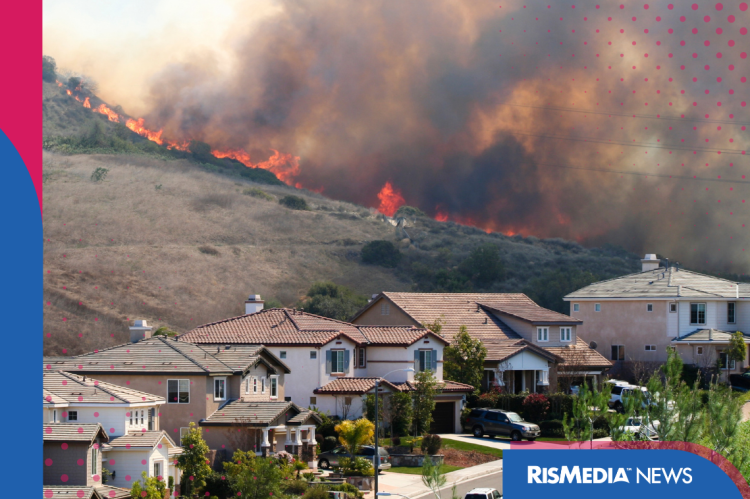
As climate change continues to impact housing markets, there are some indications that buyers aren’t immediately dissuaded by long-term climate risks when home shopping. The new 2026 Realtor.com® Housing and Climate Risk Report corroborates this while also delving into the specifics of climate cost burdens.
The report, which analyzes listings across Realtor.com from the past 12 months, finds that about one quarter of U.S. homes, 23.1%, face “severe or extreme climate risk” from wildfires, storms or flooding.
However, the report also finds that affordability concerns can actually push homebuyers to the extreme risk areas.
“Buyers are not seeking risk—but in markets where affordability has long been an issue, price is the dominant signal, and high-risk homes happen to offer the discount that makes ownership possible,” the report says.
Following the 2025 Southern California wildfires, buyer interest in high-risk homes only dropped 10% for a month before recovering.
The costs of living in these high-risk areas are apparent from the report’s findings. In particular, homeowners in these extreme risk regions face higher homeowner association (HOA) fees, high flood insurance premiums have pushed homeowners out of coverage via the National Flood Insurance Program (NFIP), and these extreme risk areas face high rates of mortgage delinquency.
On the other end of the spectrum, “lifestyle” markets still draw buyers who are willing to pay a premium for waterfront access, mountain views and river retreats, as access to these amenities seemingly outweigh an increased risk of disaster.
“Earlier climate risk disclosure is the most direct path to ensuring buyers decide with eyes open—not years later when the costs become impossible to ignore,” the report says.
Risk by the numbers
What is already at least somewhat well documented is the rapid rise in insurance costs and markets damaged by increasingly vicious storms and wildfires. Together, these are driving up mortgage delinquency rates in certain parts of the country.
As of September 2025, states with the highest rates of mortgage delinquency are Louisiana (1.7%) and Mississippi (1.4%), well above the national average of 0.8%.
The median monthly HOA fee on “typical” homes in extreme risk areas is $192, or $67 higher (53.6%) compared to the median fees of lower-risk areas. States which have the highest discrepancies between the HOA fees of low- and high-risk areas were:
- Delaware: $25 median fee in lower-risk areas, $177 in high risk
- South Carolina: $50 median fee in lower-risk areas, $296 in high risk
- Oregon: $114 median fee in lower-risk areas, $423 in high risk
- Maryland: $104 median fee in lower-risk areas, $282 in high risk
- Pennsylvania: $150 median fee in lower-risk areas, $332 in high risk
On the flood insurance front, the report pinpoints that the number of homes facing extreme flood risk (around 6%) was about unchanged year-over-year from 2025 to 2026. However, the number of NFIP contracts dropped by about 4.5% year-over-year; the conclusion drawn is a new scoring system for the insurance coverage has led to higher premiums, and some households choosing to forego flood coverage completely.
States that saw the highest drops in NFIP contracts included Texas (7.8% drop), Oklahoma (6.9% drop), Mississippi (6.6% drop), Alabama (6.5% drop) and Minnesota (6.2% drop).
The report’s conclusions about how these prices impact buyer behavior circles back to affordability; upfront price matters more to some buyers than potential long-term risks. There is also the fact that areas at high risk of flooding or such disasters tend to come with lifestyle attractions (i.e., living on the coast), that some buyers might be willing to pay more for. To this end, the report concludes that the best path is upfront disclosure about climate risks to buyers.
“Climate risk disclosure is not to steer buyers away from high-risk homes and not to discourage homeownership in the communities where people want to live,” the report summarizes, “but to ensure that when buyers make that decision, the long-term financial costs attached to climate risk are part of the picture from the start, not a surprise discovered years later when they become impossible to ignore.”
Click here to read the full report.