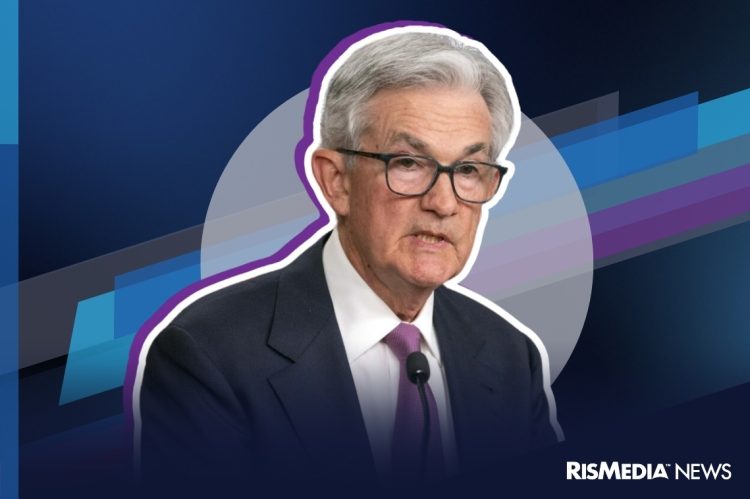
Above, Fed Chair Jerome Powell
The Federal Reserve has announced its third interest rate cut of the year—its third in a row—closing out its final Federal Open Market Committee (FOMC) meeting of 2025.
The FOMC announced at its December meeting today that it has cut interest rates by a quarter-percentage point. This follows a 25-basis-point cut in October and brings the rate from a range of 3.75% – 4.0% to a range of 3.5% – 3.75%.
There were three dissents.
Stephen I. Miran preferred to lower the target range for the federal funds rate by half a percentage point. Austan D. Goolsbee and Jeffrey R. Schmid voted for the rate to remain unchanged. Miran and Schmid were the two dissenters during October’s FOMC meeting.
During a FOX News segment this morning, Scott Turner, secretary of Housing and Urban Development (HUD), shared that he was hopeful that the Fed will cut and “continue to” cut rates.
Realtor.com®’s Chief Economist Danielle Hale noted that mortgage rates have been steady to slightly higher between the October and December Fed meetings.
“Despite the modest upward drift, current rates are not much higher than their lowest levels in more than a year. The Realtor.com 2026 Housing & Economic Forecast anticipates that mortgage rates will largely hover around current levels throughout 2026,” Hale shared in a statement. “While this may be disappointing to buyers hoping for even lower rates, mortgage rates are expected to be low enough to offset price gains, causing the monthly cost of buying a home to drop in 2026 for the first time since 2020 even as home prices rise.”
Bright MLS Chief Economist Lisa Sturtevant explained that today’s rate cut will translate into lower short-term borrowing costs.
“However, potential homebuyers waiting for lower mortgage rates are going to be disappointed. In fact, rates could actually increase in the coming weeks,” Sturtevant said in a statement. “Expect 2025 home sales to come in at about 2024 levels with a seasonally slow December. Economic uncertainty is going to be a key factor in the housing market as we head into 2026.”
In the press conference following the decision, Fed Chairman Jerome Powell said that despite dissents, there was overall agreement on several fronts.
“Interestingly, everyone around the table at the FOMC agrees that inflation is too high and we want it to come down, and agrees that the labor market has softened and that there’s further risk,” Powell said. “Everyone agrees on that. Where the difference is, where do you weigh those risks and what does your forecast look like.”
Ultimately, the Fed is in a good position to wait and see how the economy evolves, Powell told reporters. He did note that they need to be careful when it comes to data.
“We’re going to need to be careful in assessing, particularly the household survey data,” he said. “There are very technical reasons about the way data are collected in some of these measures, both in inflation and in the labor market, so that the data may be distorted, and not just more volatile, but distorted.”
When asked why the FOMC decided to cut today rather than wait until January, Powell pointed to the labor market data and to inflation.
“Gradual cooling in the labor market has continued. Unemployment is now up three-tenths from June through September, payroll jobs averaging 40,000 per month since April…Surveys of households and businesses both showed declining supply and demand for workers, so I think you can say that the labor market has continued to cool gradually,” Powell said. “Services inflation is coming down, and that’s offset by increases in goods and that goods inflation is entirely in sectors where there are tariffs.”