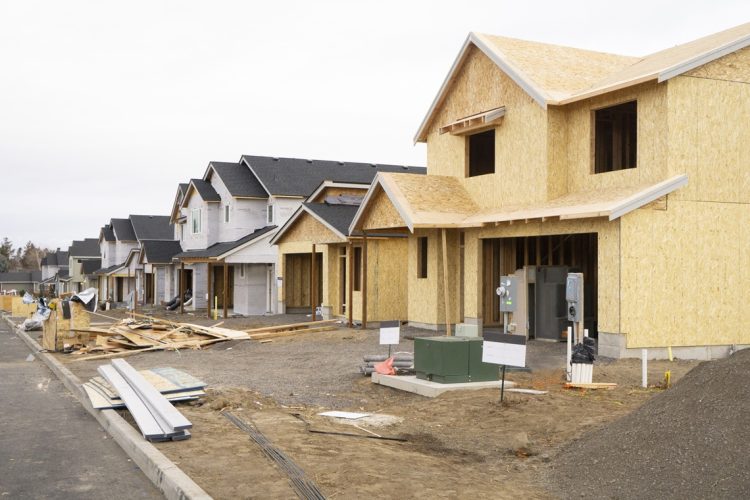
Homebuilders appear to be showing some signs of measured optimism as new construction showed significant gains against the tide of market challenges and the ongoing conflict with Iran, according to the latest data from the Department of Housing and Urban Development (HUD) and the Census Bureau.
The New Residential Construction report for March (which also includes initial data for February) found that housing starts were at a rate of 1.5 million, a 10.8% jump from February’s rate of 1.36 million. Starts are also now up 10.8% year-over-year from 1.36 million in March 2025. Of note, March’s data would have been gathered after the conflict with Iran began back on Feb. 28.
Single-family starts were at a rate of 1.03 million, up 9.7% from February’s rate of 941,000, and up 8.9% year-over-year. This is a strong reversal from the downturn observed in single-family starts from the beginning of the year. Multifamily starts were at a rate of 446,000, up 9.6% from February’s rate of 407,000, and up 13.5% year-over-year.
Regional data was also strong both month-over-month and year-over-year across three of the four regions. The Northeast was up 24.8% month-over-month and 18.9% year-over-year, the South was up 9.1% month-over-month and 14.1% year-over-year, and the West was up 7.2% month-over-month and 8% year-over-year. The only differing region was the Midwest, which was up 12.2% month-over-month, but saw a slight fall of 0.9% year-over-year.
The increases nearly across the board in housing starts suggest “builders are responding to pockets of improving demand despite ongoing affordability challenges,” as stated by the National Association of Home Builders’ (NAHB) Chairman Bill Owens.
Owens noted that despite positive reports, “activity remains sensitive to interest rate movements and construction costs.”
“Overall, the uptick in housing starts is a positive development for residential investment and signals that the sector may be stabilizing,” he continued.
Data on building permits, on the other hand, demonstrate that “sensitivity” Owens mentioned. Permits were at a rate of 1.37 million in March, down 10.8% from February’s rate of 1.54 million, and down 7.4% year-over-year from a rate of 1.48 million in March 2025. Single-family permits were at a rate of 895,000, down 3.8% from February’s rate of 930,000, and down 7.9% year-over-year. Multifamily permits were at a rate of 427,000, down a whopping 23.5% from February’s rate of 558,000, and down 5.3% year-over-year.
Permits were also down month-over-month across all four regions, while the Midwest and the West saw small year-over-year gains (the Northeast and the South saw declines).
Realtor.com® Senior Economist Joel Berner noted that the pullback in permitting observed in this month’s report “shows that (the) optimism (of builders) is balanced with some caution about the economic realities they face.”
“Builder margins are being squeezed by rising material costs that stem from today’s geopolitical uncertainty on top of the already-high costs of land and labor, so it’s unsurprising to see them exercising some caution about future projects,” he continued.
The data for completed homes was the most mixed in the report. Completions were at a rate of 1.37 million in March, up only a slight 0.1% from February’s rate of 1.36, but down 12.8% from a rate of 1.57 in March 2025. Single-family completions were at a rate of 896,000 in March, down 4.8% from February’s rate of 941,000, and down 14.5% year-over-year. Multifamily completions were actually up 10.2% month-over-month, from 410,000 in February to 452,000 in March, but were down 9.1% year-over-year.
Regional completions were a highly mixed bag. The Northeast was up month-over-month and year-over-year, while the Midwest and South were both down month-over-month and year-over-year. The West was up month-over-month, but down year-over-year.
Berner did note to take completions data “with a grain of salt,” as the “seasonal adjustments during off-peak months can exaggerate the results.”
Overall, Berner said that while the strong starts data this month is “encouraging,” he noted that there is “more to the story of new construction this month” as builders “strategically” wait to see how the conflict with Iran progresses.
“For buyers it remains a good time to purchase new construction, as price reductions and incentives continue to be offered and some markets have a wealth of new home options to choose from,” he concluded.