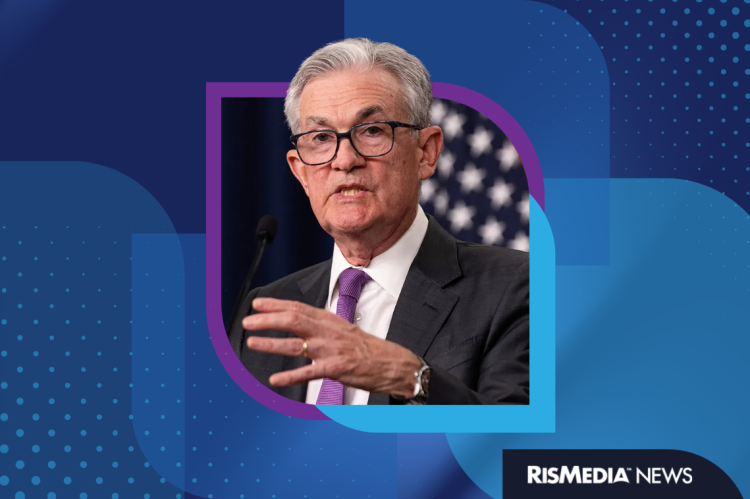
Jerome Powell’s reign at the Fed may be at its end, but he’s not going anywhere.
On Wednesday, the Federal Reserve held interest rates steady at its April Federal Open Market Committee (FOMC) meeting, leaving the federal funds rate unchanged at a rate of 3.5%-3.75% for the third straight month since December’s quarter-point cut.
And amid major geopolitical uncertainty, the outgoing chair made it clear he intends to stick around after his term expires, breaking with tradition as he has faced personal attacks from the president and a criminal investigation at the tail-end of his tenure.
“My concern is really about the series of legal attacks on the Fed which threaten our ability to conduct monetary policy without considering political factors,” Powell said. “These legal actions by the administration are unprecedented in our 113-year history, and there are ongoing threats of additional such actions. I worry that these attacks are battering the institution and putting at risk the thing that really matters to the public, which is the ability to conduct monetary policy without taking into consideration political factors.”
He noted that there is widespread concern from his colleagues over these legal attacks.
Powell had anticipated retiring at this point, but said recent events left him with little choice. “I had long planned to be retiring,” he said. “The things that have happened, really in the last three months, have, I think, left me no choice but to stay until I see them through, at least that long.”
The choice not to cut rates comes as the economy faces shocks from a war in Iran, and concerns (by some) that on-again off-again tariffs will drive up inflation.
After May 15, Powell said he will continue to serve as governor for a period he described as “to be determined,” returning to a role he held for nearly six years before becoming chair.
He was direct about what the role will look like under likely incoming chair Kevin Warsh. “I plan to keep a low profile as a governor. There is only ever one chair of the Federal Reserve Board,” he said, adding that he would not be a “shadow chair.”
A divided committee
The rate decision itself came with a fractured vote.
Stephen Miran, a recent appointee of President Donald Trump, dissented, preferring to lower the target range for the federal funds rate by a quarter percentage point. Beth Hammack, Neel Kashkari and Lorie Logan also dissented, each supporting maintaining the rate, but not supporting inclusion of an easing bias in the statement at this time—language that signals the Fed’s next move is more likely to be a cut than a hike.
The last time there were four dissents was in October 1992.
When asked whether he was handing off a divided Fed, Powell pushed back on the framing.
“We have always had vigorous debates,” he said. “We’re in an unusually difficult situation. We’ve had really four supply shocks—the pandemic, the invasion of Ukraine, tariffs, and now Iran and the oil spike. Every supply shock has the capability of driving inflation up and unemployment up. It’s only natural that you have a range of views on the committee.”
Mortgage Bankers Association (MBA) Senior Vice President and Chief Economist Mike Fratantoni touched on the four dissents, saying that there are, clearly, growing concerns regarding the inflation risk in this environment.
“Inflation has increased and is likely to rise further, given the oil price shock from the war in the Middle East. The job market has also remained resilient,” Fratantoni said. “MBA’s forecast is for the FOMC to remain on hold over the forecast horizon given these trends in the data.”
On the question of rate cuts, Powell made the committee’s current position clear.
“Nobody’s calling for a hike right now,” he said, but added that cuts aren’t imminent either: “We’d want to see the backside of that and progress on tariffs before we even thought about reducing rates.”
Melissa Cohn, regional vice president of William Raveis Mortgage, touched on attempts to cut the rate, saying that they will likely be unsuccessful in the short term anyway.
“The incoming Fed Chair may try to influence the voting members to cut rates, but will be hard-pressed to do anything until the war in Iran is fully resolved and oil prices come back down,” she says. “The FOMC needs a majority to pass a rate cut, “and the vast majority are likely to continue to vote as they have previously on monetary policy,” she adds.
Independence under fire
Powell reserved some of his sharpest language for the state of Fed independence.
“I think it’s at risk,” he said bluntly. “We’ve had to resort to the courts to enforce our legal… It’s not so much independence; it’s really the ability to make monetary policy without political considerations. That’s what we’re talking about. And we’ve had to do that, and we’ve been successful so far. But that’s not over. None of that is concluded yet.”