 RISMEDIA, November 13, 2010—(MCT)—As autumn settles in and we set back the clock, rake the leaves and stoke the furnace, we have a lot of assumptions about the most environmentally friendly ways to proceed. But are those assumptions right? We’ve gathered a bushel of answers to some popular, autumn household eco questions.
Q: What is the most environmentally friendly way to dispose of my leaves?
A: The best option is to leave a coat of leaves on your lawn and chop them up with your lawn mower to create a layer of mulch that will break down and give your lawn nutrients. This is most easily done when the leaves are dry and crunchy rather than when they are thick and soggy.
Place the rest of the chopped leaves around outdoor plants as ground cover and in your compost heap.
Burning leaves creates undesirable emissions, and it’s illegal in most municipalities. Tossing them out in sealed non-biodegradable plastic bags sends them to landfills where they can’t decompose properly and will leak harmful greenhouse gases.
Blowing them around with a leaf blower creates carbon emissions and noise pollution while eating energy and stirring up allergens. A leaf blower can be useful to push foliage to the street or curbside in municipalities that offer street leaf sweeping. A rake also works just fine for this, however. Collected leaves are taken to farms or composting sites, according to local officials.
In municipalities that don’t have leaf-sweeping days, pushing leaves into the street, “can clog the drains in the street creating blockages and other problems,” Chicago Department of Streets and Sanitation spokesman Matt Smith said.
Q: What’s the best way to save electricity on lighting despite fewer hours of daylight?
A: In these darker months the No. 1 thing you can do to save money on your lighting bills, experts say, is switch from incandescent bulbs to compact fluorescent bulbs. CFL bulbs can reduce your lighting energy usage up to 75%. Still, some consumers worry about potential mercury exposure if the bulbs break and are bothered by the harsh white glow of fluorescent bulbs. Some of these concerns are allayed by widely available plastic-coated, shatterproof CFLs and bulbs on the lower end of the lighting spectrum that are designed to mimic the warmer tones of standard incandescent bulbs.
CFL bulbs, however, cannot be thrown out in the regular garbage. Instead, they must be recycled properly through municipal hazardous-waste collection programs or brought to participating stores that offer a recycling program.
Q: I like saving money by cooking cheaper cuts of meat in a slow-cooked stew. Are slow cookers the most energy efficient way to do this?
A: Slow cooker users may assume that because the appliance has a lower wattage (70-250) than a conventional electric oven (roughly 2,000), that they save energy. But Doug Cote (www.stretcher.com), a writer for the “Dollar Stretcher” website, notes that while slow cookers’ heating elements stay on continuously, electric ovens cycle their elements on and off as needed to maintain temperature, often only about one-fourth of the actual cooking time.
Assuming you would use a slow cooker on high for twice as many hours as you would use your electric oven, the energy usage could come out equal. Efficiency can also be affected by the number of other things you can cook simultaneously in your oven, how much heat you lose when you open it and how efficient and well-insulated the oven is. The short answer: there is no clear winner in this fight.
Even more energy efficient for cooking smaller dishes is the toaster oven. And most energy efficient of all, for things that it can cook well, is the microwave.
Still, as online energy adviser Michael Bluejay (aka Mr. Electricity) points out, in terms of preserving money, energy and the environment, what you eat matters much more than how you cook it. Meat and dairy require much more energy to produce than plant-based foods, and switching to a plant-based diet, even once a week, can make a significant impact on your pocketbook, energy usage and carbon footprint.
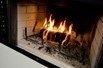
Q: I love using a fireplace but have heard that you actually lose more heat than you gain. How can I make my fireplace more efficient?
A: While fireplaces can be aesthetically pleasing, they are one of the most inefficient heat sources available, according to the EPA. Because most of your warm air goes up the chimney, experts have typically seen only a 10-20% heat return from wood logs, in the best-case scenario. Burning traditional logs can also greatly diminish indoor air quality with unhealthy gases and particulate matter, even when the fireplace is properly maintained.
Better options: If you choose to build a fire in your home, make sure your fireplace is in good shape and equipped with heat-retaining features (including blowers, intake tubes and radiant grates and inserts). And use fake logs. Now that many artificial logs have gone “green,” turning from petroleum-based binders to vegetable paraffin, they release 75% less carbon monoxide and 80% less particulate matter than real wood, according to the EPA. Plus they burn hotter, giving you a better chance of deriving some heat from them.
If you want to use recycled material, consider buying so-called “java” logs made out of used coffee grounds. Or roll your own logs using old newspapers, a broom handle and some water, as recommended by the EPA. But be sure to first remove glossy inserts that can emit unhealthy fumes.
Q: What’s the best way to stay warm in my house while saving money?
A: Other than closing leaks, changing air filters once a month, insulating well and sealing your doors and windows, the best and most efficient way to stay warm, experts say, is by keeping the heat local. Set your programmable overall thermostat very low—especially at night while you are sleeping and during the day when you are out of the house—and keep your personal space cozy with space heaters, warming bricks, hot water bottles, heating blankets and heated slippers.
That said, space heaters should be used with extreme caution—especially around small children—and you should opt for those with the latest safety features, such as automatic shut-off when they tip. Keep them away from combustible materials and high-traffic areas of your home, and plug them directly into the wall instead of using an extension cord. Oil-fueled radiant heaters are considered to be some of the safest because they never get hot enough to ignite a fire. If used properly, the energy used by space heaters will amount to far less than it would cost to heat an entire home.
This doesn’t mean you should shut off central air registers in certain parts of the house. That can damage your HVAC system by creating too much pressure and overheating your furnace. If you want to close off some rooms, consult a specialist to see what works best for your particular system.
If you think it’s cheaper to maintain a constant temperature rather than letting your house cool when you’re out and then warming it up when you’re home, think again. The U.S. Department of Energy estimates that for every degree you turn down your thermostat for an eight-hour period in the winter, you can expect a correlating percentage of energy savings.
(c) 2010, Chicago Tribune.
Distributed by McClatchy-Tribune Information Services.