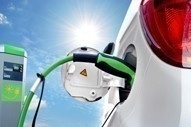
 (MCT)—Every weekday, Chevrolet Volt owners jockey to hook up their cars to the two electric-vehicle charging stations in front of General Motors’ Renaissance Center headquarters in downtown Detroit.
Even though surrounding parking structures have about two dozen similar outlets, the charging units are the most convenient for workers — perhaps even the most popular charging stations around.
“You have to get here early in the morning to snag one,” GM spokeswoman Ryndee Carney said in an email.
The thirst for electricity is somewhat unique to downtown Detroit, which has a disproportionate number of Volt owners.
But it illustrates a broader issue that confronts electric-vehicle owners throughout the country and is slowing the pace of EV adoption. There’s just a smattering of publicly available charging stations throughout the U.S. Though more come online every day, charging infrastructure is still lagging.
There are 4,688 EV charging stations throughout the U.S., compared with about 129,000 gasoline stations, according to the Department of Energy and the Census Bureau.
Here are five charging issues the auto industry faces:
Dueling Technology: GM, Ford, Chrysler and the major European automakers back a fast-charging technology called J1772, while Japanese automakers support a standard called CHAdeMO. Industry observers view the conflict as similar to the 1980s debate between VHS and Betamax or the 2000s debate between Blu-ray and HD DVDs.
“Both of those charging technologies do, in fact, work,” says Lee Stogner, senior member of the Institute of Electrical and Electronics Engineers and managing principal of Vincula Group. “It’s just that for electric vehicles to become commonplace in the years ahead, one will have to be dominant.”
The J1772 standard got a boost Oct. 15 when it was endorsed by a 190-person committee of the Society of Automotive Engineers, or SAE International.
Automakers and suppliers “now have a global standard by which to continue their development for their vehicles and charging stations,” said Andrew Smart, SAE International’s director of industry relations and business development.
Few Public Chargers: Owners of vehicles such as the Volt and Nissan Leaf must work to find charging stations away from home. Many download smartphone applications to locate charging outlets. But most workplaces and public destinations don’t have chargers.
Still, Pike Research projects that sales of electric-vehicle charging unit parts will increase from 200,000 in 2012 to nearly 2.4 million in 2020.
Abe Shocket, manager of advanced engineering for TE Connectivity’s hybrid and electric mobility solutions division, says that ideally there would be two to three charging stations for every electric vehicle.
“I see charging infrastructure growing at nearly the same pace as EV adoption,” he said.
Charging Takes Hours: Using a standard 120-volt home outlet, the Chevy Volt takes all night to fully charge. Homeowners can install a 240-volt charging system, which cuts the charging time in half. But the industry is actively pursuing technological advancements that would dramatically reduce charging time.
EV startup Tesla Motors has created a network of superchargers at six locations in California, allowing owners of the Tesla Model S luxury electric sedan to get 150 miles of charge in 30 minutes. Tesla wants to install more superchargers throughout the country.
“Without a network available to charge quickly, ownership of an electric vehicle is very limiting,” Tesla spokeswoman Shanna Hendriks says. “By putting down the infrastructure for fast charging, it opens up the possibilities and the destinations that you can travel in an electric vehicle.”
Still, experts say that for mass adoption of electric vehicles, charging time needs to be reduced to five to 10 minutes — the same amount of time it takes to fill up a tank of gasoline.
That will involve advancements in battery chemistry, software capability, charging infrastructure and electrical grid capacity.
“If I have to pull into a charging station and it takes six to eight hours, well, the debate’s over — people will not buy that,” Stogner says.
Drivers Must Have A Garage: One significant limitation to electric-vehicle adoption is that many car buyers don’t have a garage. Most apartment dwellers, for example, can’t charge a car at home.
Shocket says it’s a mistake to “assume everyone’s got a garage with a plug in it.”
Single-family homeowners are the most likely early adopters of electric vehicles. Auto companies are partnering with utilities and other groups to make it easier for car buyers to install special charging systems in their garages.
Electricity Demands: Utilities view electric vehicles as a new source of business. But they would have big problems if everyone immediately switched to electric vehicles and started charging during the day or during hot summer months, when electricity demand is at its highest.
That’s why utilities are moving to encourage people to charge at night by offering cheaper electricity rates, says Hawk Asgeirsson, engineering manager for Michigan utility DTE Energy.
Grid managers also are coordinating with automakers and suppliers to allow consumers to use software applications that coordinate charging times with off-peak hours.
Asgeirsson says 85 percent of DTE customers who own electric vehicles are charging at night, when the electrical grid can easily handle the demand. DTE is studying EV electricity consumption “to see what’s happening with customers’ behavior,” he says.
©2012 Detroit Free Press
Distributed by MCT Information Services