Moving from a starter home to a bigger one is exciting. The family is usually growing, careers are blossoming and more room is needed. For downsizers, it’s mostly the opposite. The kids are gone, retirement age has either been reached or is close at hand, and the cycle of life is apparent. As such, emotions can play a key role for many people, and agents must understand and be hand-holders to a point.
“Downsizing goes with aging, in most cases, but not always,” says Splendore. “Dealing with seniors requires a certain level of delicacy, as they are often resistant or have turned the reins over to a younger family member. It is best to identify the contact person and work with them. Often there are power struggles or turf wars, and one must proceed with caution. I try to be as understanding as possible, particularly if a death is involved.
“And downsizing is emotional. One chapter of a life is closing, another is opening. These all involve changes, and change can be painful. I compromise, emphasize teamwork and even arrange to donate clothing, household goods and furniture. I avoid telling sellers that I can ‘sell’ their belongings for a profit, as that is a slippery slope. I am also the ‘bad guy’ who orders the dumpster and arranges permits for it to be on the street for a limited time to get rid of the debris.”
The financial aspects may seem purely positive when downsizing, but they are not always. Retirees may be without the liquid assets sometimes needed for a major transaction.
“There is definitely a significant trend of homeowners contemplating downsizing,” says Perrin. “I have this conversation more and more these days. People who are retired and now on fixed incomes are looking for a richer life experience, often with travel and dining. A cushier cash flow to do that often involves downsizing to increase the principal they are working with and reduce the carrying costs of larger homes.
“There is a lot of number crunching. I spend a lot of time guiding homeowners through it. Many do not factor in closing costs, how long it will take, the possibility of having to carry two properties for an undetermined period, etc. Some homeowners still carry a mortgage on their current home. I recently had a conversation with a prospective seller with good equity in her home, but has a 1% interest-rate mortgage and is obviously hesitant to give that up. For people who still have mortgages on their current homes, the capital gain on that has to be substantial to make for a suitable next chapter, because homes are more expensive and interest rates are often perceived as still high when compared to what they once were.”
Being unable or unwilling to maintain a large home is another reason older people are looking to downsize, notes Lindsay, asserting that agents with expertise in helping clients in those situations will be more and more in demand.
“A majority of the time people are looking to downsize due to age-related mobility issues, their children have left the nest and there is a general need for less space to take care of as they age,” she says. “Sellers like this will make very obvious their reasons for downsizing, and those reasons are often a critical pain point for why they want and/or need to move, often from spaces where they have spent most of their adult lives.
“Downsizing will continue to grow in demand over the next decade as the country’s population ages, and agents who can properly support and guide older people through a home-buying journey that is very different from what they experienced decades ago will become increasingly popular.”
“I see people downsizing starting as early as their 50s,” adds Decatur. “Typically, a few years after the kids move out, folks get tired of taking care of such a big house. They start to resent the maintenance, cleaning and upkeep. Next thing they are looking for something on one floor in a walkable neighborhood.”
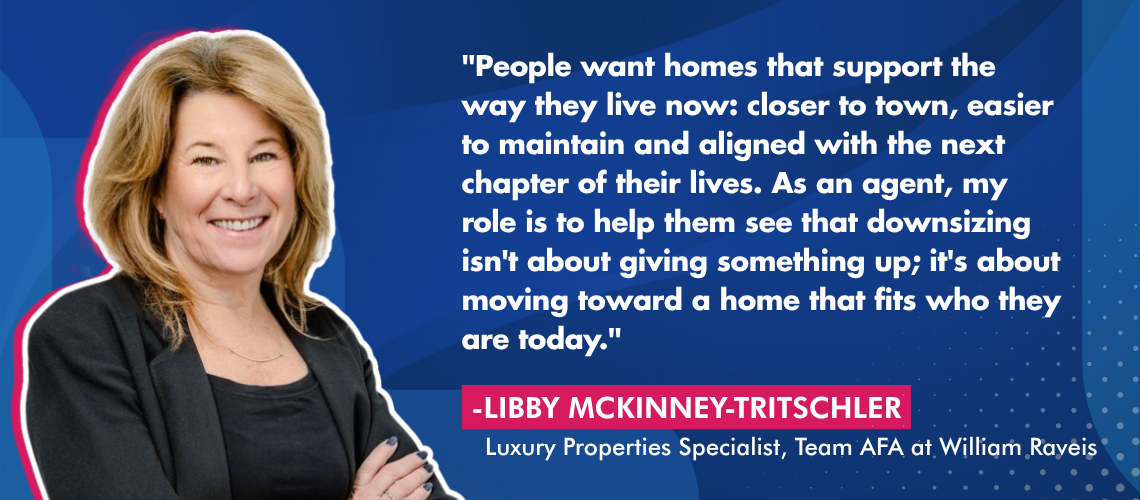
To that end, McKinney-Tritschler posits that downsizing today is less about square footage and more about intentional living.
“People want homes that support the way they live now: closer to town, easier to maintain and aligned with the next chapter of their lives,” she says. “As an agent, my role is to help them see that downsizing isn’t about giving something up; it’s about moving toward a home that fits who they are today.
“While many are selling a property they’ve owned for 20 or 30 years, I’m also seeing a second group emerge: clients who once maintained two homes and are now simplifying by selling their larger primary residence and transitioning their secondary property into their full-time home. Low inventory has definitely influenced this trend.”
Harris is a Seniors Real Estate Specialist who just turned 60, “so I know a thing or two about this topic,” she says. “There are 70 million Americans 65-plus years old. And 25% of sellers are 65-plus. Many of my friends have kids who have moved out and are starting their own families, so it makes sense to downsize and eliminate upkeep, lawn maintenance and utilities for the larger homes. Also, a huge draw is grandparents wanting to move closer to the grandkids to help out and spend more time with their families.”