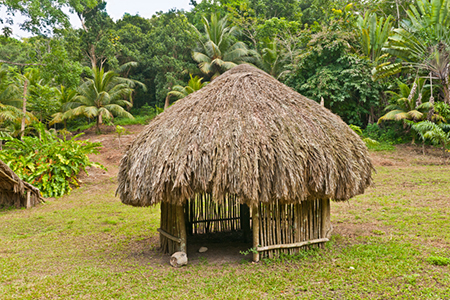
 The shift from living in jungle huts to cities has dramatically changed human exposure to certain microbes, which could have implications for healthy immune function, according to a study led by researchers from NYU Langone Medical Center and published online February 12 in Science Advances.
“Our study found that urban living spaces increase the number of human-associated microbes we are exposed to, while decreasing our exposure to the outdoor, environmental microbes with which humans co-evolved,” says microbiologist Maria Dominguez-Bello, PhD, lead author of the new study, which was funded by the Alfred P. Sloan Foundation.
Microbes inhabit our surroundings as well as our bodies, and the potential health impact of the interplay between bodily and environmental microbial species is worthy of study, say the authors. Thus, their first mission was to detail the microbial changes that occur across a gradient of urbanization.
“The remarkable changes in home microbial content across differing levels of urbanization raise the possibility that the reduced microbial exposure to environmental bacteria seen in modern homes contributes to immune and metabolic disorders, from asthma to obesity, which have become the new disease paradigm in the industrialized world,” adds Dominguez-Bello, an associate professor in the Department of Medicine at NYU Langone. “That said, our pilot study was small in size and limited to one geographical region, so larger studies are needed before we can generalize these patterns.”
The research team—which included architects, environmental engineers, and microbiologists from the United States, Puerto Rico,Brazil, and Peru—examined microbes on the walls and floors of homes in the Amazon river basin. The dwellings ranged from an isolated Amerindian community at the Ecuador-Peru border to a small Peruvian village to the large town of Iquitos in Peru to the Westernized, Brazilian city of Manaus. The team collected samples from ten houses in each location, and then used state-of-the-art genomic and statistical techniques to analyze the mix of bacterial DNA from each sample.
Combining their samples and available databases, the team applied statistical tests that accurately tracked the sources of the bacterial microbes on each floor and wall. Specifically, they found more human bacteria in the town and city houses, such as Streptococcaceae and Lactobacillaceae, and decreasing proportions of environmental bacteria.
On the other hand, the bacteria found on the floors and walls of rural and jungle living spaces were proportionally higher in environmental bacterial species, including soil bacteria, like Mesorhizobium and Luteimonas from water sources, as well as Rickettsiellacarried by spiders and insects.
Importantly, the researchers also found that the many walls that define urban homes come to reflect the sources of human bacteria, which in turn depend on the function of a given room. Kitchens and bathrooms, for instance, acquire function-dependent microbial signatures, such as oral Streptococcus and gut Enterobacteriaceae in bathrooms, and food-associated bacteria in kitchens.
“Excessively humanized spaces that are poorly ventilated could increase transmission of pathogens,” says Dominguez-Bello. “Understanding the consequences of architectural changes on microbial exposures will be important to improving future home design and ultimately to human health.”
Other key contributors to the study were from the University of Puerto Rico in Rio Piedras, and included Jean Ruiz-Calderon, a PhD student from the Department of Biology; Humberto Cavallin from the School of Architecture; Luis Pericchi in the Department of Mathematics and Rafael Rios in the Department of Environmental Sciences. Also making important contributions were Se Jin Song atUniversity of Colorado, Boulder; Rob Knight at the University of California, San Diego; Henrique Pereira of the Federal University of Amazonas, Manaus, Brazil; Luciana Paulino of the Center for Natural Sciences and Humanities, Federal University of ABC, Santo André, SP, Brazil; and Atila Novoselac in the Department of Civil, Architectural and Environmental Engineering, University of Texas at Austin.
Source: www.nyulangone.org