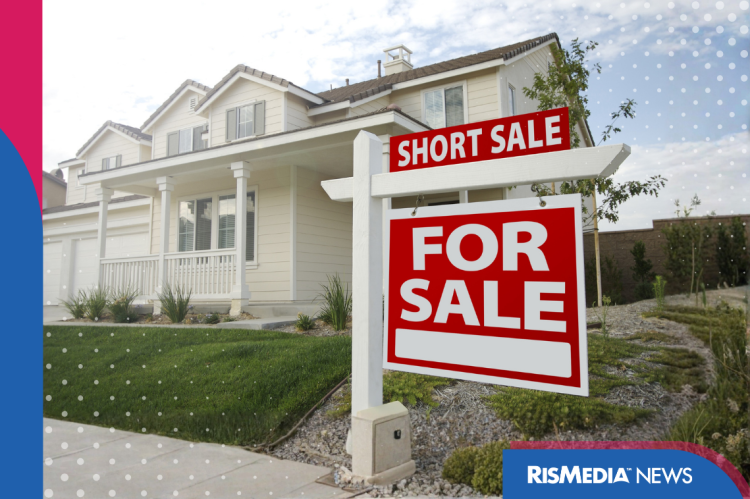
Short sales—frequently a rarity of the housing market, except for the duration of the Great Recession housing crisis—are making a bit of a comeback, according to a new report from Realtor.com®. The data, however, does not necessarily show cause for concern just yet.
For those not familiar, a short sale is when a homeowner sells their property for less than what they still owe on the mortgage. Typically they are most commonly used by homeowners with underwater mortgages (meaning they owe more on their loan than the property’s current market worth) they can’t afford, in order to avoid foreclosures.
When the market crashed in the Great Recession, Realtor.com noted that roughly a quarter of homeowners had underwater mortgages through the period, and short sales rose to 10% to 15% of all home sales by 2009–2010. In fact, the portal stated that in 2009-2010 alone more than a third of all home sales were either foreclosures or short sales. Additionally, short sales peaked in 2012 to a rate of 358,000 sales.
While the market normalized and returned to a more “status quo” era for many years, with distressed and short sales taking up less and less shares as time went on.
However, the affordability challenges facing the housing market appears to have pushed the trend back up in prominence. Realtor.com found that in 2024-2025 short sales were up 4% from 2023 to 2024, 10% from 2024 to 2025, and as of Q1 2026 they are up 16% year-over-year and occupy 28% of all distressed sales.
Yet, Realtor.com Chief Economist Danielle Hale said it’s not necessarily cause for concern.
Even with affordability challenges in the market, ATTOM data as of Q1 2026 only shows about 3.2% of mortgaged homes as underwater. Additionally, while up year-over-year, short sales only occupy 0.6% of transactions, a small portion and significantly below historical peaks.
Hale said that “even in a strong economy with home prices close to record highs, a small segment of households find themselves facing tough circumstances.”
She explained that the good news nowadays for struggling homeowners is there are more options than in the past.
“A short-sale can be complicated and requires borrowers to act before the bank forces their hand; however, it benefits them by shortening the waiting period before they can qualify for a future mortgage,” Hale continued. “Foreclosures are the more common outcome, but borrowers facing difficulty should consider all of their options.”
Additional good news comes in the form of sale prices. Typically short sales are discounted, with Q1 2026 recording a 20% discount of home prices in these sales. Realtor.com found that the trend has reversed, and short sales now sell for roughly 9% more of their estimated value.
The report also noted that this appears to be a return to a trend seen back in the Great Recession, as data from the Philadelphia Federal Reserve Bank saw short sales sell for roughly 9%-10% more than foreclosures from 2007 to 2012.
Realtor.com Economist Intern Glen Morgenstern did note, however, that many struggling homeowners may still continue to lean toward foreclosures for their underwater mortgages in order to remain in their homes until they can determine a plan for the future.
“A foreclosure lets them stay in the home without paying for 592 days on average,” he continued. “That free housing is worth more than any credit or timeline advantage a short sale offers, and the new pricing math doesn’t touch that calculation.”