
 In the April 2015 iteration of the Senior Loan Officer Opinion Survey (SLOOS), the Federal Reserve Board included a special question on residential real estate lending. That special question asked banks about how they had responded to new guidelines issued by the GSEs on November 20, 2014, on the definition of life-of-loan representation and warranty exclusions. These policies were designed, in part, to reduce uncertainty and increase transparency about the conditions under which securitized mortgages would be returned to the bank that originated the loan.
In response to the new GSE-issued guidelines, and given information about only the credit score and the down payment amount, banks’ likelihood of approving mortgage applications largely varied with the credit score. Given a consistent down payment amount, banks were more likely to approve mortgage applications from households with higher credit scores and were less likely to approve mortgage applications from those households with comparably lower credit scores. In contrast, the amount of the down payment, holding the credit score constant, had little discernible impact on banks’ likelihood of approving a household’s mortgage application.
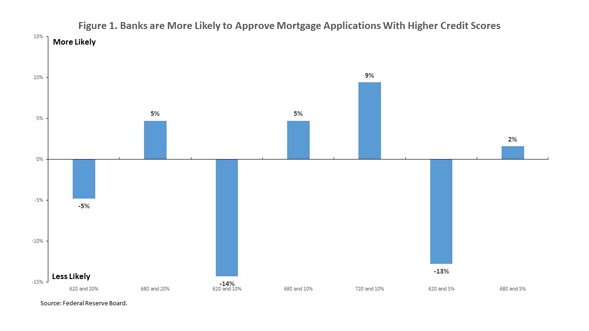
Figure 1 shows the banks’ likelihood of approving a mortgage application on net. The net likelihood of approving a mortgage application under a given credit score and down payment is equal to the percentage of banks saying that they are more likely to approve a mortgage application minus the share of banks saying that they are less likely to approve a mortgage application under the given credit score and down payment information. The share of banks saying that the approval was “about the same” is not included. As a result, a positive net percentage means that banks are more likely to approve the mortgage application and a negative net percentage means that banks are less likely to approve the mortgage application.
According to the figure, banks, on net, were less likely to approve mortgage applications with a credit score of 620 and a down payment equal to 20 percent of the home’s value, but they were more likely, on net, to approve a mortgage application when the credit score jumped to 680, but the down payment remained at 20 percent. This pattern holds with lower down payments. As the figure illustrates, at a 10 percent down payment, banks, on net, were less likely to approve a mortgage application if the credit score was 620, but more likely, on net, to approve it if the credit score was 680, and even more likely to approve the application, on net, if the credit score was 720. Even with a down payment of 5 percent, banks were, on net, more likely to approve a mortgage application if the credit score was 680 and less likely, on net, if the credit score was 620.
However, no matter the down payment amount, banks were less likely, on net, to approve a mortgage application if the credit score was 620, but they were more likely, on net, to approve the mortgage application if the credit score was 680 or above.
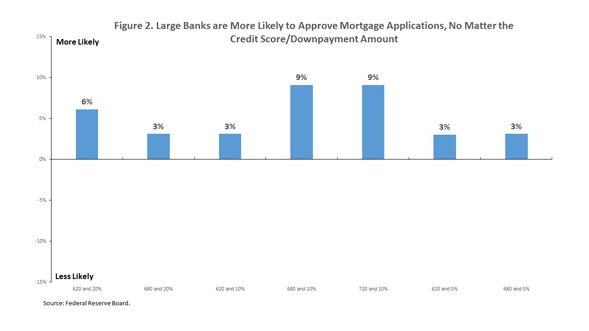
Variation across all bank respondents masks the different responses to the GSE-issued guidelines by bank size. The Federal Reserve’s SLOOS distinguishes responses by large national banks and smaller, but not small, regional banks. Figure 2 depicts the answers provided by senior loan officers at large banks. In response to the new GSE-issued guidelines, large banks, on net, are more likely to approve mortgage applications, no matter the credit score or the down payment amount.
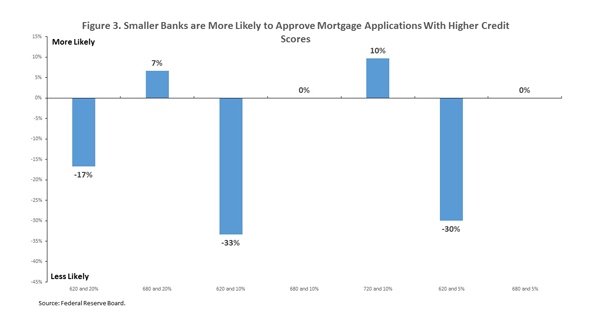
However, holding the down payment amount the same, the response of smaller, regional banks to the new GSE-issued guidelines varies by credit score. As shown in Figure 3, smaller regional banks, on net, were less likely to approve a mortgage application with a credit score of 620 and a down payment of 20 percent. However, when the credit score rose to 680, while the down payment remained the same, banks, on net, were more likely to approve the mortgage application. Similarly, mortgage applications with a credit score of 620 and a down payment of 10 percent were less likely to be approved by banks, on net, but when the credit score rose to 720, banks were more likely, on net, to approve the mortgage application. At 680, with a down payment of 10 percent, banks were indifferent, an equal number of banks were more likely and less likely to approve the mortgage application. Even at a 5 percent down payment banks were, on net, less likely to approve a mortgage application with a 620 credit score, but were equally more likely and less likely to approve the application if the credit score rose to 680.
In addition, responses among smaller, regional banks varied by down payment amount, but only if the credit score was sufficiently high. As shown in Figure 3, an equal number of banks were both more likely and less likely to approve mortgage applications with a credit score of 680 and a down payment of 5 percent, and the same holds true for mortgage applications when the down payment rises to 10 percent but the credit score remains the same. When the down payment rises to 20 percent and the credit score remains at 680, smaller, regional banks are more likely to approve the mortgage application, on net. However, if the mortgage application’s credit score falls to 620, then smaller, regional banks are, on net, less likely to approve the mortgage application no matter the down payment amount.
This original post was published on NAHB’s blog, Eye on Housing.