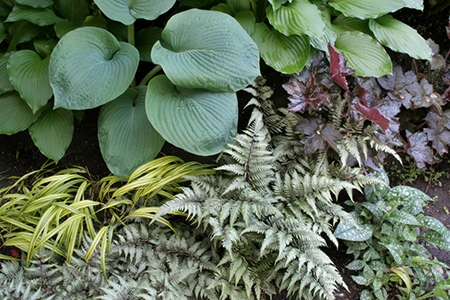
 (TNS)—Hostas are the workhorses of the shade garden. Once they’re established, they’re pretty much low-maintenance plants. They tolerate periods of drought, and they are reliably hardy in areas that freeze during winter. They often sport big beefy leaves with interesting textures and colors that range from chartreuse and gray-blue to lemon-splashed green.
But a giant carpet of hostas—especially those with solid green leaves—can be boring. So we’ve asked a horticulturist, an artist-gardener and a plant breeder to share their favorite shade garden plant combinations.
The horticulturist: “I love the cultivated forms of our native alumroots, and for me Heuchera (villosa) ‘Autumn Bride’ is one of the best,” says horticulturist Barbara Ellis, who blogs at Eastern Shore Gardener and is author of “Covering Ground: Unexpected Ideas for Landscaping With Colorful, Low-Maintenance Ground Covers” (Storey). “It forms a large clump of bold leaves and plumes of foamy flowers late in the season when not much else is in bloom. I like it with variegated knotweed (Persicaria virginiana ‘Painter’s Palette’) and hostas. This combination is great under and around shrubs as a ground cover.”
In her garden in Chestertown, Md., Ellis grows several native plants in full shade under an oak tree. “Since there are not many flowers in the fall garden, I always like to add patches of wreath goldenrod (Solidago caesia) and either white wood aster (Eurybia divaricata, formerly Aster divaricatus) or blue wood aster (Symphyotrichum cordifolium, formerly Aster cordifolium).” She notes that all of these plants bloom in fall in partial to full shade, and they are beneficial for pollinators, such as bees and butterflies.
“The asters self-sow and show up elsewhere in the garden, another bonus as far as I am concerned,” Ellis says. “I have this trio paired with spring-blooming wild blue phlox (Phlox divaricata), another self-sower, native Allegheny pachysandra (Pachysandra procumbens), plus hellebores and epimediums. The result is a tough, hardy combination.” The hellebores and epimediums bloom in the spring and tolerate dry shady soil once they are established. And another bonus: Deer and rabbits tend to leave them alone.
The artist: Artist Mary Ann Nowak of Tinley Park, Ill., paints many of the flowers she nurtures—but getting a big floral display in shade is often difficult.
“My garden is changing—what used to be sunny is now becoming shady in spots, so right now it’s in transition,” Nowak says. One of her favorite shade plant combinations is pink-flowered turtlehead (Chelone lyonii ‘Hot Lips’) with purple-leaved coral bells (Heuchera micrantha ‘Palace Purple’). “It’s going great,” Nowak says. “I like it because Chelone blooms later in the summer, and it stays in one spot—no spreading.”
Nowak also recommends planting Actaea simplex ‘Hillside Black Beauty’ (formerly Cimicifuga simplex) for its strikingly dark foliage and long, slender spikes of cream-colored fragrant flowers. She combines it with low-growing yellow corydalis (Corydalis lutea) or a blue-flowered variety (C. flexuosa). “The yellow corydalis bloomed longer than the blue, but blue is nice because there aren’t as many plants with blue flowers available for shade.”
The plant breeder: Brent Horvath, plant breeder and owner of Intrinsic Perennial Gardens, in Hebron, Ill., discovered one of his favorite combinations while visiting a private garden. “It was variegated Brunnera, Primula sieboldii (Japanese primrose) and Dicentra eximia (fringed bleeding heart). It was synergistic,” Horvath says. (Japanese primrose, however, may be difficult to find, though many primroses on the market can be worthy substitutes.) “I also love Primula veris (English cowslip) with Lamprocapnos spectabilis (old-fashioned bleeding heart, formerly Dicentra spectabilis)—pink and yellow together is a favorite. You can also plant Polygonatum ‘Prince Charming’ (Solomon’s seal) with anything short. It works with almost anything and has so many great attributes—fragrance, sun or shade, dry shade, purple berries and golden fall color.”
Like Ellis, Horvath also touts barrenwort (Epimedium) as an outstanding companion plant for shade. “Epimedium ‘Purple Pixie’ has great wine-colored flowers and great purple foliage,” he says. Its delicate heart-shape leaves and dangling spring flowers create an interesting contrast with hostas and ferns.
Varying degrees of shade
Knowing how much direct sunlight (if any) reaches your plants is key to matching plants to the site. Remember, too, that sunlight in spring and fall is less intense because the sun is at a lower angle in the sky.
— Full sun. Plants receive a minimum of six hours of sun each day, typically from May through August. This could be 8 a.m. to 2 p.m., 10 a.m. to 4 p.m., etc.
— Light shade. Plants receive sunlight filtered through a lightly branched tree (like a birch tree or a honey locust).
— Partial shade. Plants receive some sunlight for part of the day — a few hours in the morning, at midday or in the afternoon.
— Full shade. Plants receive no direct sunlight. Some examples include plantings under densely branched evergreens, under a sugar maple or in the shadow of a tall building or under a deep overhang.
©2015 Chicago Tribune
Distributed by Tribune Content Agency, LLC.