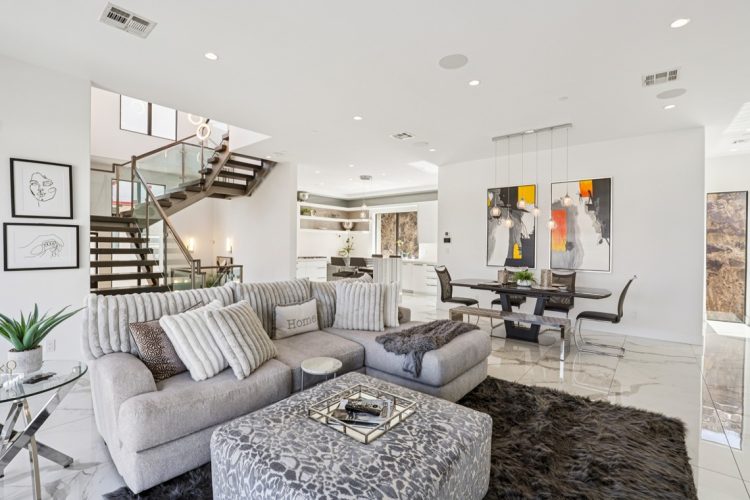
Above, a listing photo of a room staged by Alexandria Pearl.
Homes are not purchased with logic alone. They are purchased with emotion.
Thoughtful staging creates the emotional connection that allows buyers to envision their life unfolding within a space. I often refer to it as the “Disney effect” for homes. It’s about creating an intentional experience designed to inspire, not simply a display of square footage
I stage 98% of my listings because the presentation directly impacts perceived value. When a home feels elevated, cohesive and intentional, buyers subconsciously associate it with quality and desirability. That perception translates into stronger offers.
Most buyers struggle to visualize potential in a vacant property. Empty rooms can feel sterile and disproportionate. In owner-occupied homes, personal décor, dated furnishings, clutter, or even scent can create distractions that dilute emotional impact. Meanwhile, resale properties compete directly with impeccably staged new-construction models. Builders invest heavily in staging for a reason: they are selling a lifestyle. Buyers instinctively measure every home they tour against that benchmark.
The data reinforces what I see every day. Reports from Realtor.com and professional staging groups show that staged homes frequently sell 6% to 20% closer to list price, with premium properties sometimes exceeding that range. In my experience, thoughtfully staged homes create demand and urgency. My listings consistently go under contract faster, often with multiple offers and fewer days on market, even in today’s more balanced, buyer-friendly environment.
The first showing happens online
Today, the first showing is almost always digital.
Buyers discover homes on Zillow, Redfin and brokerage platforms long before stepping inside. According to the National Association of Realtors®’ 2024 Home Buyers and Sellers Report, 97% of buyers begin their search online, and photography is the primary factor in determining whether they pursue a property.
In many instances, clients send me listings they have discovered online before we even discuss scheduling tours. If the photos do not make an immediate impact, the home may never make it onto their must-see list.
Research suggests buyers form a first impression within seven to 10 seconds of viewing listing photos. In reality, it is often even faster. In today’s scroll-driven environment, we are competing for two to five seconds of attention. That means the first one to three photos must be exceptional.
If a property appears dark, cluttered or poorly composed online, buyers arrive skeptical and prepared to negotiate aggressively. If it presents as bright, intentional, and aspirational, they enter emotionally receptive and more inclined to justify value. By the time buyers walk through the door, a narrative has already formed in their minds.
Staging for the camera, not just the walkthrough
As discovery has shifted online, staging has evolved. It is no longer solely about how a home feels in person; it is equally about how it translates through a lens.
Live staging remains the most powerful strategy, but it now requires a nuanced understanding of photography: Camera angles, lighting, scale, contrast and spatial flow. Neutral palettes, balanced proportions, layered lighting, and subtle texture photograph beautifully. Simplicity and cohesion create visual calm and visual calm performs exceptionally well online.
Overly bold color schemes, heavy contrast, excessive accessories and hyper-personal design choices can overwhelm the camera and subconsciously deter buyers.
Virtual staging, when executed transparently and responsibly, can also be effective—particularly for vacant properties. In markets like Las Vegas, where we attract relocation buyers from California, New York and beyond, offers are often submitted based entirely on digital content and virtual tours. That reality makes high-quality visuals not optional, but absolutely critical.
The financial impact of presentation
Poor presentation costs sellers tangible dollars.
Limited visual appeal leads to fewer showings. Fewer showings typically result in extended days on market. Extended days on market often necessitate price reductions and increase carrying costs. Instead of positioning a home at the top of the comparable range, poor presentation can push it toward the bottom.
According to NAR member surveys and industry performance metrics, homes staged prior to listing spend 73% less time on the market compared to similar non-staged properties. That time advantage translates into leverage, negotiating strength and stronger net proceeds.
In short, presentation influences power.
When a seller says, “It shows better in person,” I gently remind them that if the online presentation does not compel buyers to schedule a showing, they may never experience it in person. The same 2024 NAR report indicates that 98% of buyers prioritize move-in-ready homes. Strategic staging reinforces that perception of readiness. You cannot fall in love with a home you never step inside.
In today’s market, staging is not a cosmetic luxury. It is a strategic marketing investment.
The new first showing is online. The scroll is immediate. Attention is limited. Buyers are making emotional judgments within seconds.
When a home is staged thoughtfully and presented with intention, it does more than look beautiful. It creates demand. It builds urgency. It protects value.
And in a competitive, digitally driven landscape, that distinction makes all the difference.
For more information, visit https://alexandria.huntingtonandellis.com/.