Real estate agents have heard plenty about AI over the past couple of years. But for many, the hype surrounding AI has overshadowed a fundamental truth: AI isn’t here to replace agents; it’s here to help them reclaim their most valuable asset—time.
As the industry navigates this technological shift, a new wave of agents and brokers are already experiencing the tangible benefits of AI integration. They’re using it to automate administrative tasks, enhance their marketing reach and ultimately spend more time on the human interactions that actually close deals.
The question is no longer whether to use AI, but how to use it strategically to grow your business in 2026.
AI as your high-level assistant, not your competition
One of the most persistent concerns among real estate professionals is that AI will eventually replace human agents. But according to industry leaders actively using AI, this misconception misses the point entirely.
Instead of viewing AI as a threat, the most successful agents are treating it like a highly intelligent assistant—one that handles the low-impact, time-consuming tasks so agents can focus on what machines cannot do: build genuine relationships.
“Use the robots for the low-impact activity, so that you can free up time for the high-impact activity,” emphasized Wendy Forsythe, chief marketing officer at eXp Realty, during RISMedia’s Rocking in the New Year panel, “Game-Changing AI Strategies That Will Help You Do More and Earn More,” moderated Kymber Lovett-Menkiti, CEO of KWCP and regional director for the Keller Williams Maryland/DC region, Keller Williams Capital Properties; featuring Matthew Rathbun, executive vice president of Coldwell Banker Elite; Kelly Sand, a Realtor® at CENTURY 21 Morrison Realty; and Wendy Forsythe, CMO of eXp Realty.
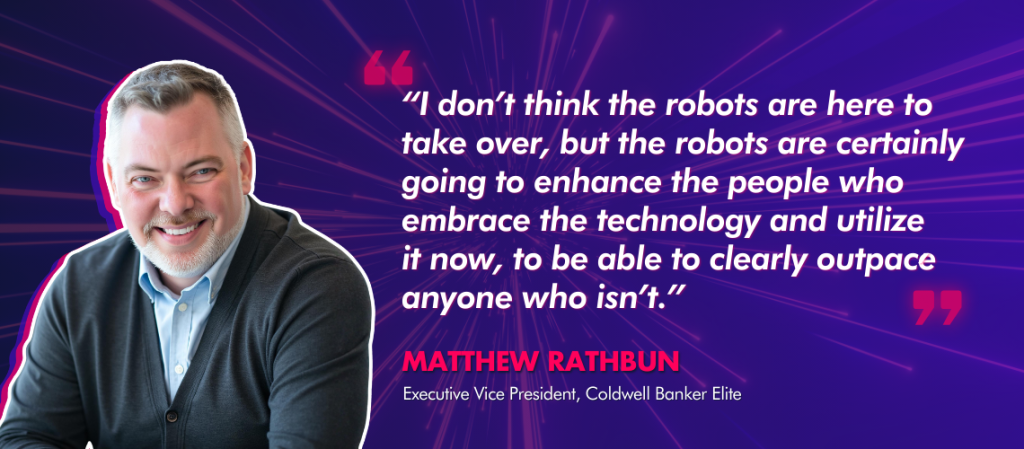
Recent data, explained panelist Matthew Rathbun suggests the opposite of displacement. Real estate transactions conducted with an agent reached the highest percentage in recorded history in 2025, a trend that industry experts attribute partly to the increasing complexity and confusion in the market. As more tools, content and information flood consumer channels, people are actually seeking more human guidance, not less. AI is amplifying the need for trusted advisors who can cut through the noise and provide personalized direction.
“I see a gravitation toward more humanity, needing more of a human guide to go through this complex process, not less,” Rathbun said. “I don’t think the robots are here to take over, but the robots are certainly going to enhance the people who embrace the technology and utilize it now, to be able to clearly outpace anyone who isn’t.”
Reclaiming time: The real ROI of AI
When real estate agents talk about time as their greatest asset, they’re not exaggerating. Every hour spent on administrative tasks is an hour not spent prospecting, nurturing relationships or closing deals. This is where AI is delivering immediate, measurable returns.
One of the most effective time-saving tools gaining traction is email management AI. Tools like Fyxer integrate directly into your inbox and handle everything from categorizing your incoming emails to drafting responses in your voice, noted Forsythe.
The platform learns your communication style, tone and preferences, then puts draft responses in your inbox for your review before sending. It can even schedule meetings by connecting to your calendar, she added.
“It allows you to then be face to face and doing those high-value tasks in your business, where AI can do the administrative assistant work,” noted Forsythe.
For agents managing multiple leads and follow-ups, AI note-taking and organization tools are preventing deals from slipping through the cracks. Rocking in the New Year panelist Kelly Sand who leverages AI for business management, emphasized the power of organizational systems.
“As agents, you read all these books by professionals to manage your time block, but that’s almost impossible to do as an agent because things come up,” Sand said. “When you run into that person at the grocery store who says, ‘Hey, I’m thinking about selling in three months,’ you make a note to yourself, and the next morning it is in your list of stuff to follow up with. That way, you have the details and you’re making sure that follow-through is timely.”
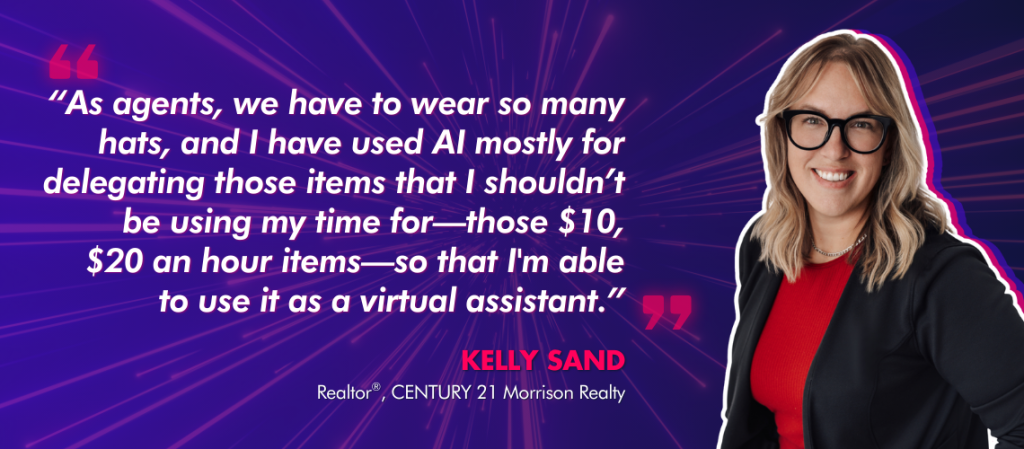
By delegating administrative tasks to AI, Sand is able to focus on the things that matter. “As agents, we have to wear so many hats, and I have used AI mostly for delegating those items that I shouldn’t be using my time for—those $10-, $20-an-hour items—so that I’m able to use it as a virtual assistant.”
Building custom marketing solutions without code
One of the most transformative developments for individual agents is the emergence of “Vibe-Coding”—AI-powered no-code platforms that allow non-developers to build custom applications.
Consider an open house. Traditionally, you might use a generic sign-in app or tablet. But with platforms like Loveable.dev, an agent can build their own custom open-house app—one that collects visitor information and automatically syncs directly to their CRM.
A visitor signs in on an iPad, their contact information flows into the system and the agent’s follow-up sequence triggers automatically. All of this is built, owned and controlled by the agent themselves, with no coding required.
“Through these AI systems…we can create what I call the loop—these marketing loops that we can create because of tools that we can vibe-code,” explained Rathbun. “The power that we have as individual agents is just incredible…You can build anything.”
Mastering social media and email marketing with AI
In a digital-centric real estate market, your social media presence and email communication are fundamental to your brand. Yet both are traditionally time-consuming to produce consistently. This is where AI tools designed for marketing become essential.
ChatGPT, Gemini, Claude and other platforms, like Jasper, are helping agents dramatically improve their social media output and email effectiveness. Rather than manually writing posts for multiple platforms, an agent can input one core idea into Jasper and have it automatically adapt, customize and schedule posts across Facebook, Instagram, LinkedIn and other channels.
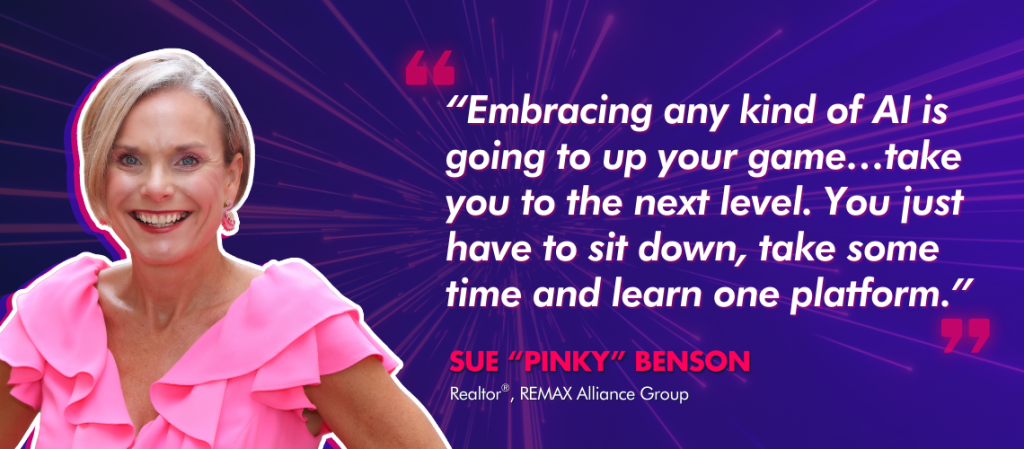
“Embracing any kind of AI is going to up your game…take you to the next level,” shared Sue “Pinky” Benson during the Rocking in the New Year session titled “From AI to Social Media: How to Modernize Your Marketing for a Digital-Centric Consumer,” moderated by Jackie Louh, COO of Lamacchia Realty, Inc; featuring Rob Cleapor, CEO of Iron Valley Real Estate; Shannon Murree, Realtor® with REMAX Hallmark Chay Realty; and Sue “Pinky” Benson, Realtor® with REMAX Alliance Group.
“You just have to sit down, take some time and learn one platform,” she added. “Don’t feel like you have to do all the different bells and whistles that are out there. Take one; learn it and then go from there.”
Specializing in streamlining execution, panelist Rob Cleapor emphasized the broader value proposition.
“I use it to eliminate friction, to speed up execution, to make things smoother and easier; it’s really time compression,” he said. “It takes those tedious tasks off of your table and allows you to spend more time with conversations, with building relationships with your clients.”
Personalization and brand consistency
While AI can generate content at scale, many agents worry that machine-generated content will sound generic, robotic or inauthentic. This is where intentional personalization becomes critical.
The most effective approach is to build a detailed “memory” of your brand, voice and personality into whatever AI tool you’re using. This means telling the AI specifically how you communicate, what words you use, what you avoid and what expertise you want to highlight.
Rocking in the New Year panelist Shannon Murree who went from resisting AI to embracing it strategically, shared her approach, explaining how you have full control over how much you want to customize and train your AI to your voice.
The real payoff: More presence, better connections
Perhaps the most compelling benefit of adopting AI isn’t the time saved or the content produced. It’s the improved quality of human interaction that results from having more mental space and availability.
When an agent isn’t worried about a to-do list a mile long, they can be fully present in a client conversation. When administrative tasks are handled automatically, there’s mental bandwidth for strategic thinking about each client’s unique situation. When content creation is streamlined, there’s time to actually pick up the phone and have meaningful conversations.
Sand described this benefit directly. “I’m able to be more present in that time because I’m not worried about my million tasks on my to-do list. Nothing is being dropped. Everything is organized, so I’ve just felt like I’ve had better connections with people because of it.”
This is the paradox of AI in real estate: the tool that might seem to reduce the human element actually amplifies it. By removing friction from routine tasks, AI creates space for the things that actually matter—understanding a client’s goals, building trust and guiding them through a significant life decision.
The agents getting ahead in 2026 aren’t the ones avoiding AI. They’re the ones using it as intended: as a tool that frees them to do what they do best—guide clients and close deals.