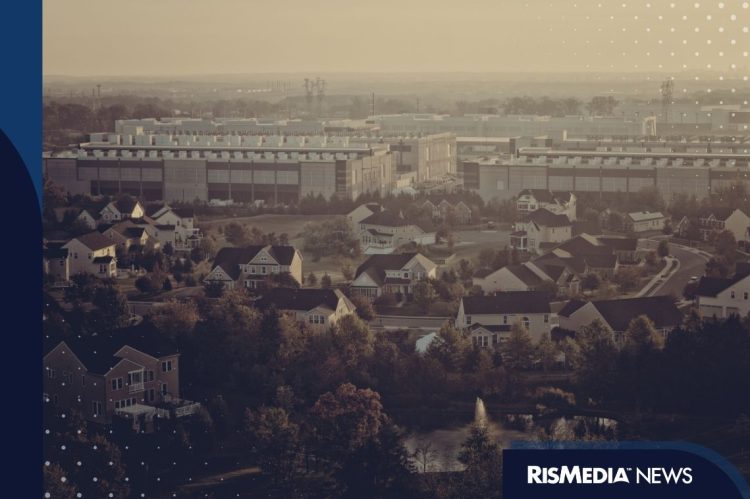
In the technological revolution of AI, more and more data centers that house the processors and servers for this tech are being built across the country, and they’re getting bigger and bigger.
As AI continues to become more popular, and the data centers continue to grow, there are many questions at play in real estate of just how much this growth might affect the housing market—positively or negatively.
A new report from Realtor.com® breaks down some of the questions surrounding housing and data centers: Where are the centers building, is buying increasing near centers, are home prices being affected, and more.
The report found that home sales in the areas surrounding data centers have more than doubled since 2018 to 2026, from 0.67% to roughly 1.5%, as the number of centers rapidly expanded from 49 to 347. Based on this trend, Realtor.com predicts that the share will approach 2.3% of all U.S. home sales.
Realtor.com noted that the report is based on home sales, listings and property tax records, coupled with facility-level data center insights from Aterio—which tracks data center construction and operations across the United States using satellite imagery.
According to the data, however, homebuyers aren’t necessarily moving toward data centers—the centers are moving closer to them.
The report details that the entire aforementioned increase in home sales near data centers “traces back to facilities that didn’t exist in 2018 opening in new communities, not to more home-sale activity in neighborhoods that already had one.”
Where the centers are building
Data centers have been shifting out of the tech centers and large cities they were originally building back in 2015, and they are now expanding out to more rural areas for more land.
Realtor.com found that, compared to 2017, the median large data center is surrounded by about 70% less homes, and are averaging about 27 miles from the nearest city centers. Following this trend, in 2027 data centers will average about 34 miles from the nearest city centers (up 26%).
Additionally, data centers have been shifting more and more into lower income areas. From 2020 to 2023, centers were built in areas that typically ran above the national median income—such as in the Northern Virginia suburbs, which ran 24.7% above the median income. As of 2026, however, centers are now being built in areas that run on an average of 2.1% below the national media income. Following the trend, in 2027 centers will be built in areas that run 5.7% below the national median income.
Glen Morgenstern—economist intern at Realtor.com—noted that the “places absorbing this next wave of data centers look different from the places that absorbed the last one.”
He explained that the shift to “lower-income, lower-density” areas further from city centers also means fewer resources—“fewer attorneys, less organized civic engagement, and housing markets that react more slowly to new information.”
“That doesn’t tell us those communities will be worse off, but it does mean they may be less equipped to respond if a facility turns out to be a difficult neighbor,” he continued.
How the centers affect housing
There are many concerns surrounding the cropping up of data centers in people’s neighborhoods, but not all have shown to have merit, according to the existing data.
Housing inventory has seen positive improvement from data centers, according to the report, while home prices have seen virtually no effect.
Realtor.com found that inventory has been more stable in the areas surrounding data centers. Neighborhoods surrounding data centers retained 66% of their active for-sale listing activity in the three years after a center opened, compared to just 43% of listing activity retained for non-center neighborhoods. New construction also trended higher in the first three years after a center opened in a neighborhood.
As for home prices, the report compared the home values and listing prices in 43 zip codes that gained a large data center between 2019 and 2025 against similar zip codes, and saw that both groups moved pretty much in line with one another, with no dispersions or differences of note.
Realtor.com Chief Economist Danielle Hale said that the data center buildout “has moved fast and it is raising policy, community and housing-market questions as it spreads and accelerates,” but that this report “offers some reassurance.”
“In the communities we studied, a new data center opening nearby wasn’t associated with meaningfully higher or lower home values than similar neighborhoods that didn’t get one,” she explained.
However, Hale also noted that the centers coming in the future are “bigger, more remote and landing in communities with less experience managing an industrial neighbor, so that track record may not hold as a guide to what comes next.”
The power question
Perhaps the biggest concern of all amongst those living near data centers is that of power.
According to the report, the average data center in 2026 drew 60 megawatts of power due to generators and cooling infrastructure. Electricity and water use in these data centers is a large concern for those living nearby, especially because the Sun Belt—specifically Georgia and Virginia—is already experiencing water shortages and rising utility bills from their data centers.
Realtor.com noted, however, that as of March 2026 seven of the major AI companies building data centers signed a Ratepayer Protection Pledge “committing to cover the cost of new power supply and grid infrastructure rather than pass it on to residential customers.”
The report also noted that this commitment “has since expanded to companies representing 80% of U.S. power delivery.”