

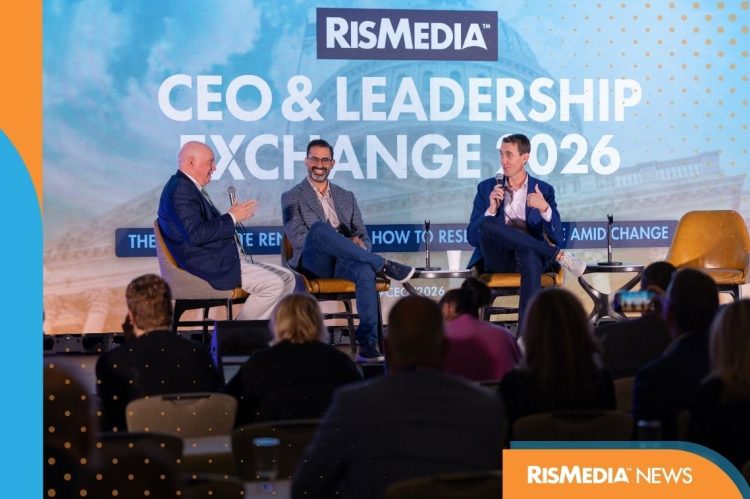
Above, from left: John Featherston, Leo Pareja, James Dwiggins. Photo by AJ Canaria.
Consolidation has been one of the most talked about trends in real estate this year—and the conversation continued at RISMedia’s 38th Annual CEO & Leadership Exchange when Leo Pareja and James Dwiggins joined John Featherston on stage to dig deeper into eXp Realty’s acquisition of NextHome.
Addressing about 400 of the nation’s top real estate leaders during the session titled, “Consolidation Up Close,” Pareja—who recently took the reins of AGNT, Inc., the parent company of eXp Realty and NextHome, Inc.—emphasized that people are at the heart of the virtual-focused brokerage’s acquisition strategy.
“Our thesis for acquisition is actually human-based, so if we like and see really cool, smart, on-brand folks, we try to do business with them,” said Pareja, who noted that the combination solved a really specific pain point.
“In the five years I’ve been at eXp, if we’re competing for a solo agent, or we’re competing for a team, or we’re competing for a mega team…we are the best product-market fit solution that exists in my opinion,” he added.
Living through what he refers to as the “financialization of organized real estate,” Pareja called attention to a big distinction, noting that 20 years ago, there wasn’t a single national brokerage, while there have always been national brands.
“We’re the only animal in the world that does it like we do,” said Pareja, of the firm’s 63,000 agents across 50 states who closed 343,000 transactions in 2025. Now that the two organizations have combined, that number has risen to 87,000 agents working across 29 countries.
“And so we needed a platform because what we believe is that there’s a lot of people waking up to a new parent company…and what this bet was is that there’s going to be a lot of folks who are going to wake up and have a renewal, and maybe have a different opinion of their parent company. And some of them may be more aligned with our vision of the world,” he added.
“You can’t be all things to all people, and so, as a brokerage, we can define it in 14 words, which is we are a platform to empower entrepreneurs to build whatever size dream they want,” explained Pareja.
Bigger footprint, same foundation
For Dwiggins, the significant financial capital and larger market footprint are two of the biggest benefits he’s witnessed since becoming part of a bigger organization.
With just shy of 6,000 agents across the U.S., the NextHome president found himself contemplating a fundamental question: How does this company survive in a world where the MLS potentially doesn’t exist?
“To put it bluntly, what happens if five or six companies decide to take all their inventory out of the MLS?” he pondered. “To be clear, if eXp and Keller and REMAX and Berkshire Hathaway and Compass all decided (to) no longer play in the same sandbox, you’re going to lose 60% to 70% of the inventory—and the whole system collapses. And unless you’re heavy on the list side, then you don’t have a defensible space.”
The decision, according to Dwiggins, centered on fulfilling his fiduciary responsibility to his members while delivering on his commitments and working with a company that’s not only extremely well capitalized but moving into markets he’d previously been unable to reach.
Drilling down further, when asked about how NextHome operators have accepted the acquisition, given that the entire corporate team made the transition, Dwiggins pointed specifically to culture.
“Culture is defined by the leaders in the room. It’s what you say, it’s how you respond, it’s how you act. It’s why Leo and I ended up working together because we view things the same way,” said Dwiggins, who pointed to being aligned on what the leadership team looks like at AGNT and how they view the industry as the No. 1 decision in the process.
“We aren’t stopping what we’re doing; we’re adding on top of (it),” said Dwiggins, who explained that culture is being able to say “this person doesn’t fit our values and vision, and so we aren’t going to have them come in and mess up that culture. And we’ve been able to protect that.”
That commitment to preserving NextHome’s identity was reinforced from the get-go, he added, through the way in which the acquisition was approached.
In fact, Pareja made it clear that Dwiggins was going to run what he had built and continue to do exactly what he was doing in order to enhance what he had created.
As the business continues to scale, Dwiggins suggested that maintaining its culture begins with the operator of the franchise, at the franchisee level, and how that person looks at the world and whether they’re community focused and care about people.
“Our motto internally has been Humans Over Houses since our inception, so we look at it that way. If we continue that, and our franchise owners look at it that way, they’ll hire the right agents and that will then pass down to the consumer,” he said.
Leveling the technology playing field
Pointing to his technical background as co-founder of Remine, Inc., Pareja encouraged attendees to remain in a state of curiosity in order to survive what’s coming next on the technology front.
“When we built software 10 years ago, we had raised tens of millions of dollars. We had 200 engineers in Fairfax, not too far from where we’re sitting, and I was competing with Google and Microsoft and everybody else here,” said Pareja, underscoring the need for engineers to move away from caveman coding—aka, coding by hand rather than using one of the robots.
Pareja illustrated the difference in output from caveman coding to using Cursor or Codex or Claude Code by recounting a conversation with one of his systems architects, who estimated that “one day with his favorite robot today is about 90 days of agile development with sprints.”
Driving the point home, Pareja cited a real-time example when trying to send a group message as he took the stage just moments before.
“I didn’t like the contrast in the field when I typed the words because it was white on white, so I screenshotted it, circled it and threw it into what’s called a loop engineering chat,” said Pareja, who went on to explain that unlike traditional agile development, which relies on two-week sprints, loop engineering enables continuous development.
“I took a picture, I described it in natural language and told the robot what I want built. The robot puts it in a queue, writes the code…and it will be fixed by the time I get off stage,” he added. “Eighteen months ago, that would have taken me 90 days.”
For Pareja, the implications extend far beyond faster software development, potentially leveling the playing field for brokerages across the board.
“The thing that’s about to happen is there’s no more barrier of entry to technology, which by the way is like the ultimate leveling thing, so any small brokerage should be excited by the words coming out of my mouth,” explained Pareja. “You don’t need to have 200 engineers, $100 million in cash. You can build anything you want.”
A new phase of growth
Looking toward the future, on the NextHome side of the equation, Dwiggins anticipates aggressive and significant growth over the next few years.
“We’re going to go from being a franchise that was targeting small- to mid-size independent operations, and now because we have the capital and the size to be able to play in a bigger sandbox, we’re now starting to bring on large operators,” he said.
But it doesn’t end there. In fact, Dwiggins also noted that due to the size of the company, they can buy software at a cheaper rate than most—which wasn’t possible when working with a smaller agent count.
“We’ve created a model where I would call it much more usage-based so that the franchisee will pay less if their agents aren’t using as much stuff, or they’ll pay slightly more if the agents are, but it reduces the overhead of the cost,” he added.
And given the company’s size, the efficiencies associated with the way the brokerage operates are a completely different animal.
“The idea will be (that) an operator with us will be able to reduce their OpEx (operating expenses), increase those margins, make them more efficient than they could before. We’re taking the best of what they’ve been able to build over the past 10 years and deploy(ing) that into the franchise units,” said Dwiggins.