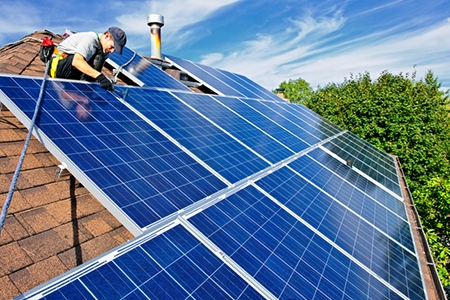
 Solar power is finally entering the residential real estate mainstream in America after years in the wilderness. The heady growth conjures up images of solar rooftop panels sprouting up as a common sight from West Coast to East Coast and points in between.
Futurist Ray Kurzweil, a noted inventor who is director of engineering at Google, is among those who believe solar will be able to meet the world’s energy needs in less than 20 years because of advances in technology and tumbling panel prices.
The Department of Energy (DOE) is only slightly less enthusiastic, estimating 30 million U.S. homes will be equipped with rooftop solar by 2050, up from about 500,000 today.
Could the DOE be too conservative? At SolarCity, one of the nation’s largest solar providers, the company says it is already installing a new solar residential customer in the U.S. at the rate of one every three minutes.
The rising torrent of residential solar energy conversions is due to a confluence of factors:
1. Traditional Utility Power Is becoming Prohibitively Expensive
Solar companies are already able to underprice electric utilities in many states, not least because utilities—as virtual monopolies in some areas—have little incentive to control their costs. Traditional electric prices tend to go up more than the inflation rate, but much bigger increases are not unheard of. (In New England, for examples, utility rates rose 30 percent to 50 percent in the past couple of years.) Utilities face fixed overhead costs, calcified business models, regulatory red tape, and are in a legacy trap of aging coal and nuclear facilities.
2. Solar Adds Value to Homes
According to a 2015 report from the DOE’s Lawrence Berkley Laboratory, solar adds significant value to homes. The study of 22,000 homes from 1999 to 2013 found that premiums for a typical residential solar system averaged about $15,000. Some of the value may be due to the “green cachet” of going solar, but homeowners are likely also motivated by the fact that electricity simply costs less in solar homes. SolarCity allows its customers to lock in low solar rates for up to 20 years.
3. Solar Is Available with Little or No Investment
Solar roof panels are starting to be offered as an option in new home construction in some areas of the United States. Lennar, the nation’s second largest homebuilder, has added them as a regular feature of new homes in California and in some other areas. Lennar concluded solar does not impede the sale of a home initially or when it is sold in the future. As for existing homes, it’s also often simple to add solar now. While residential solar customers once had no choice but to write an upfront check for thousands of dollars worth of equipment if they wanted to go solar, the industry recently has added power purchase agreements with no up-front investment, long-range financing deals with zero down, and lease options.
4. Solar Is an “Anyway” Purchase Decision
Homeowners have no choice but to buy electricity from somebody. So if they have to buy power anyway, it makes logical sense to get it from a cleaner, cheaper source rather than from dirty, expensive fossil fuel utilities.
5. Environment
When people are given a theoretical choice of coal, nuclear or solar to power their homes—with all three fuels being offered at the same hypothetical price—they usually will pick solar. Coal and nuclear are still most of what U.S. utilities currently burn, while solar is an option that is both cheaper and cleaner. The average U.S. home that replaces traditional electric utility power with solar will offset over 100,000 pounds of CO2 over 30 years—a big number that scales into measurable environmental impact originating from the individual household level. At current adoption rates, optimists say solar easily will make the world a cleaner place—one roof/family at a time.
John Morgan is an Energy Consultant for SolarCity, and offers rewards for solar customer referrals from Realtors®. To contact him, click here.