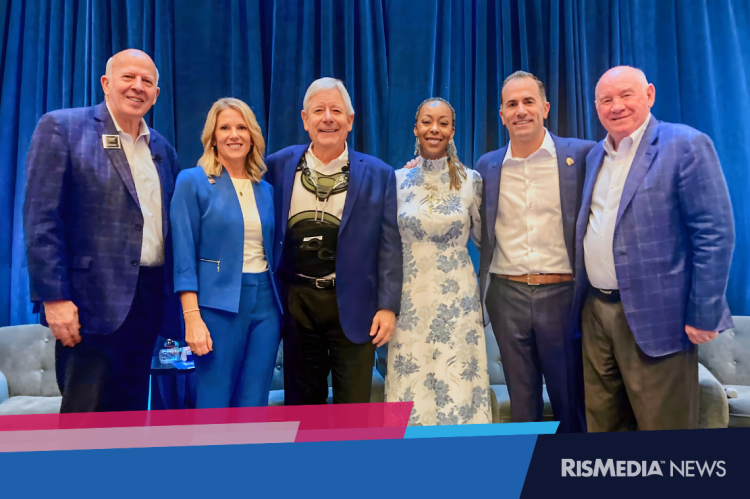
From left to right: Lennox Scott, Jennifer Branchini, Mark Woodroof, Kendall Bonner, Anthony Lamacchia and John Featherston
Over the course of its 37 years, RISMedia’s Power Broker Forum has served as a vehicle for confronting the many issues and challenges facing the residential real estate brokerage business, offering insights and strategies from many of the most dynamic and influential real estate leaders in the business. At this particular moment in time, however, the level of change and challenge enveloping the industry has perhaps never been greater. All the more reason to get busy and take action, according to this year’s Forum panelists.
On Nov. 14 during NAR NXT in Houston, RISMedia Founder & CEO John Featherston and NAR VP of Association Affairs Jennifer Branchini co-moderated the Forum, titled “The New Rules of Success. How the Brokerage Playbook Has Changed.” The pair led the discussion among four leading brokerage executives:
Kendall Bonner, Thought Leader & Strategic Growth Partner, eXp Realty
Mark Woodroof, CEO, Better Homes and Gardens Gary Greene
Anthony Lamacchia, Broker/Owner/Founder, Lamacchia Realty, Inc.
Lennox Scott, Chairman and CEO, John L. Scott Real Estate
“There’s so much going on right now in our industry,” said Featherston during his opening remarks. “There’s no better collection of esteemed professionals than our panelists and our co-moderator to talk about what’s happening, what they’re doing, how they’re finishing 2025 stronger than they expected, and what the new rules of success are going forward.”
What is—and isn’t—working
Featherston kicked off the discussion by asking panelists about their tactics for closing 2025 strong, and which of these strategies they plan to carry into next year.
Woodroof began by reporting that his firm is finishing 2025 better than 2024 thanks to changes and enhancements he put in place. With 40 years in the business, he is no stranger to upheaval and change and is, therefore, well equipped to ride the wave.
“As we sit here today, it’s a tough market,” he said. “But we always do better in challenging markets because that’s where buyers and sellers see the difference in our company and in the professionalism and knowledge of our agents. And that’s in large measure because we continue to address the ever-evolving market. I say often, ‘Let’s get in front of the parade, not get run over by it.’ That’s our philosophy.”
For Woodroof, staying a step ahead of the steadily advancing pace of change means getting face to face with managers and some 850 agents in order to understand their needs at this moment in time. Among those needs are full-time coaching, transaction support, hands-on branding and marketing assistance, and the development of individualized business plans.
Scott and his team are also focused on connecting with agents to make sure they have the necessary tools for relationship-building, leaning into tried-and-true community outreach, such as photo ops with Santa, Toys for Tots fundraising, and the creation of the firm’s 2026 Housing Forecast, an invaluable client conversation-starter for agents.
For Bonner, providing agents with a platform that allows them to “show up as leaders” is critical.
“A lot of us have run our brokerages as transaction-compliant models,” she said. “We’re here to help make sure agents can get paid on time, that they’re doing their transactions properly, legally and compliantly. But when you get beyond that, what’s the next level for your producers that want to grow beyond those basic necessities? That’s the biggest frustration and challenge that a lot of brokers have is that their agents believe they have to leave them in order to go to their next level of growth. So I believe that your opportunity is to create that space within your brokerage.”
As an example, Bonner has created a mentor program led by one of eXp’s leading agents. She also fosters a sense of community by hosting meet-ups called Coffee and Conversations, where agents can get out of the office and into the community to interact with and learn from peers.
“Every single agent in the room got to speak; they got to share,” she explained. “A lot of times, it’s not about teaching good agents new things—it’s about reminding them of what they already know, and getting them to take action on implementing what they know.”
Lamacchia concurred with panelists, adding that his firm focuses on providing silos that help agents lean into the business-building strategies that work best for them, whether it’s buying leads or providing pies to distribute at Thanksgiving.
“I was a big proponent of spending money to create leads originally on television, and then eventually also buying leads from some of the online portals,” explained Lamacchia. “And then I realized, not everyone’s good at that. But there are agents that are good at converting leads, but they’re not so much into delivering pies. So we realized we need to have these different silos of things for them to take advantage of.”
The influence of good leaders
Panelists then tackled the topic of what it takes to lead agents toward success in the year ahead.
Lamacchia, long a prognosticator of market conditions—good or bad—sees important signs that the market is improving, and is pointedly spreading these good tidings through his popular social media outlets and his weekly training sessions.
“There’s a lot of positivity that I see, and I’ve been sharing that more, and I’m already noticing it’s having a positive impact on our agents,” he said, “and I just want to remind other broker/owners of that.”
Featherston asked the other panelists how they’re engaging agents at their respective firms.
According to Scott, it’s all about leadership. “Leadership means being responsible for the conversation and keeping the conversation alive,” he said. “And that’s what we do as leaders in our offices and with our executives.”
To that end, Scott works with broker associates to identify the top 10 referral clients in their databases, and then connect with those clients for an updated home valuation to coincide with Washington state’s property tax assessment day on Jan. 1.
“This really reinforces them to be present with those in their database,” he explained. “To keep the conversation alive. I look out for them, they look out for me—reciprocity, trust, referrals and business back and forth.”
Critical to keeping agents engaged as a leader is drowning out the distractions, especially in the current climate. Woodroof tells agents, “let us worry about that.”
“The external environment, these are things you can’t control,” he explains to agents. “We’ll keep you apprised of that. What you need to be focused on is your business because you can control that. You need to go deeper, not wider—back to the philosophy of your sphere of influence, your past customers, because that’s where your business is coming from.”
Retaining agents (and knowing when to part)
Strong leadership strategies not only help agents build business. They also help brokers build retention.
“When we think about why our agents choose to be with us as brokers, what are the things that you are either reinforcing or changing within your brokerage?” Branchini asked the panel.
Lamacchia reported that he recently changed up his company’s approach to recruiting and retention, moving from a centralized business development team to a regional sales manager model as his firm rapidly grew from six offices to 22.
“When we jumped to 22 offices, it didn’t work because our recruiters were getting spread too thin and they couldn’t possibly build relationships in the different markets,” he explained. “It’s an example of when something is screwed up in your business, you have to be willing to change it. I’m not scared—if I know something’s wrong, we’ll change it no matter how uncomfortable it is. If you’re not willing to change, then you’re going to get run over. It’s a constant thing. In a year or two, there will be something else that I’ll realize needs adjustment, and we’ll do it.”
Bonner agreed, stating that one of the core values at eXp is remaining agile. “Being one of the largest independent brokerages on the planet, that feels like a Titanic ship to move, yet we do it,” she said. “We’re not afraid to be the first to do something and to innovate. And part of the reason we are able to do that is because we keep our ear to the ground and we listen to our agents.
“We also take action on big ideas,” Bonner added, referencing eXp’s recent launch of its “CRM of Choice,” designed to allow agents a greater say in the tools that work best for their individual needs. “We added tool upon tool upon tool so that our agents can build the tech stack that supports their business.
“I would encourage brokers, as you’re thinking about your business and its next evolution, think outside the box,” she added. “It’s okay to be the first to do something. It’s also okay to learn from your peers. As you go into 2026 (ask) where do you need to pivot? Pivoting is not a bad word, where it is necessary in order to help your business grow.”
To create an environment agents will remain loyal to, Scott reinforced the need to help agents build relationships from their database. As he puts it, “We’re teaching the lost art of engagement.”
A tactic his firm has succeeded with, for example, is reaching out to past clients on the anniversary of their home purchase.
“Only 5% of agents across the nation contact their past buyers,” he said. “And ‘happy home anniversary’…come on, it’s low-hanging fruit. It’s the happy call. That’s where referrals happen. That’s where reciprocity happens.”
And, Scott added, his firm has the systems in place to facilitate such database engagement. “We get out a list to every agent with their past buyers so they can go through to see if they still live there. And then we put it into the system of when that home anniversary is. So we’re the infrastructure to help our broker associates with the engagement, and that’s where business takes place.”
Woodroof pointed out that activities such as those Scott highlighted are what make the difference between the top 20% of agents who are successful and the remaining 80% who aren’t—no matter what the market challenges of the day happen to be.
“Our top people are having better years and they’re growing their business,” he said. “Why? Because they do these (activities). We talk about accountability. Well, guess what? It’s personal accountability with them because they understand the business. The other thing is execution. Great ideas are a dime a dozen. Can you execute the strategy that aligns with who you are?”
Branchini honed in on the concept of accountability, citing the proverbial “you can lead a horse to water, but you can’t make them drink.”
“How do you hold (agents) accountable if they’re not actually meeting any of their goals?” she asked the panel. “And is there a point where you’re not afraid to say, ‘thank you very much, but maybe this is not the place for you to be anymore?'”
“As a broker, you cannot be afraid to let people go,” responded Bonner. “That is your No. 1 strongest tool in the tool belt.
“But this makes me think about something even bigger and deeper, which is, when you started your brokerage, what is it that you aspired to create?” Bonner continued. “Was it a place for people to manage transactions and close a lot of deals? Or did you want to build something that changed people’s lives? And when you think about having a real impact on agents and, therefore, the consumer, it’s about creating meaningful impact.”
To that end, Bonner said it’s critical to talk to agents about their mindset. “A lot of agents will change brokerages, they’ll hire a new coach, but guess what? They take themselves with them everywhere they go. The secret is their identity. Your level of success will never outperform the identity that you have for yourself. So until you can help them see themselves, which will allow them to achieve success…until they get there and they move all the garbage out of the way, they’ll never actually perform to their highest potential.”
Lamacchia agreed and added an important reminder: brokers set the bar.
“Look at what you’re doing every day as the leader,” he said. “How can you as the leader be telling the people to make dials, if you’re not making dials? How can you, as a leader, tell people to get out and visit clients if you’re not getting out and visiting people? I’m showing up every day. I’m working every day. I’m dialing the phone. I’m dealing with challenges, front and center. That trickles down to the executives, to the managers, to the agents, to the staff, et cetera. So if you’re someone who maybe has gotten a little comfortable, if you want to grow your company, it starts with you and what you do every day and the effort that you put forth. Believe me, what you do, whether it’s good, bad, hardworking or lazy, people are noticing.”
Woodroof concurred. “On my desk, I have a little plaque. It says, ‘The sled doesn’t move any faster than the lead dog.’ Every morning when you get up, say, ‘Hey, if it’s going to be, it’s up to me.’ It isn’t going to be somebody else that makes it happen. You’ve got to be willing to do the things other people won’t do. Great agents have to be willing to do the things other people don’t do.”
Bonner doubled down on that sentiment, sharing one of her favorite quotes from author Alvin Toffler: “The illiterate of the 21st century will not be those that cannot read and write, but those that cannot learn, unlearn and relearn.”
“My challenge to each of you is to think about what is it that you need to unlearn and what is it that you may need to relearn in order to show up differently, show up better and empower your people heading into 2026,” she said.
“We know that the only constant is change,” said Branchini. “Nothing is new that isn’t old, right? It just keeps coming around. So we as brokers and managers and agents, just keep your head down, keep evolving your business and making sure that you’re creating value and are not afraid to change as you move forward into this next exciting chapter.”
“The reality of today pales in comparison to the bright future ahead in 2026,” said Featherston in closing. “I believe that, and I have been covering this industry for 47 years. We have a tremendous opportunity in front of us with your great leadership, with your dedication, with your mentoring and your coaching.”