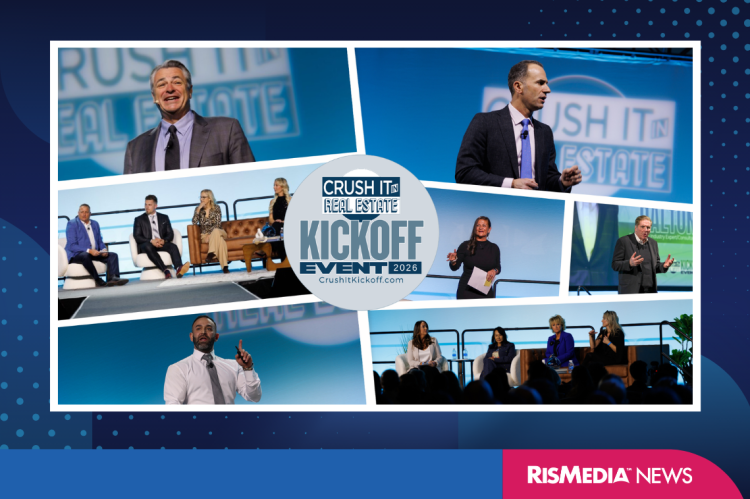
Despite the single-digit temperatures and icy sidewalks in Worcester, Massachusetts, last week, the crowd gathered at the DCU Convention Center was fired up.
“The people who show up here are the real do-ers.”
That’s how Anthony Lamacchia, CEO and owner of Crush It In Real Estate and Lamacchia Realty, described the standing-room-only crowd of more than 1,000 people in total who came to be part of the 2026 Crush It In Real Estate Event on Feb. 5. Representing the largest audience to date—composed of not just Lamacchia Realty’s own, but agents from brokerages across New England and even South Florida—the packed house was a clear indicator of the growing popularity of Lamacchia’s Crush It In Real Estate training program, as well as a signal that what was once an annual company gathering has evolved into a powerful, regional educational event.
The half-day program was marked by an impressive speaker lineup, starting with an inspirational kick-off message from cancer survivor Erica Berkenbush Kinney and ending with a powerhouse presentation from real estate guru Brian Buffini. Lamacchia Sales Director Jason Posnick provided practical, no-nonsense success strategies for the crowd, and industry icon Allan Dalton challenged agents to raise the bar on professionalism and skills, introducing a new certification program to help them reach higher levels of success. The agenda also included two panel discussions, one featuring top agents, the other, top team leaders from various companies. In both sessions, panelists got granular about their journeys, sharing details of their successes as well as their missteps.
Of course, Lamacchia himself was an integral part of the event, walking the crowd through the opportunities in this year’s market, and how to seize them. His message was loud and clear—and also just what the doctor ordered.
“For those of you in the last three years—which is pretty much everyone in this room—who have lived through this incredibly aggravating real estate slowdown, I congratulate you for being here today and for trucking through it because, mark my words, when we get to the end of this, which we’re almost there, we’re going to see business take off like crazy.”
Lamacchia zoomed in on data and market trends to illustrate the opportunity in the coming months, emphasizing important shifts that will raise the tide for all boats. Pointing to a report in the Wall Street Journal, he explained how the market is transitioning from a seller’s market to more of a buyer’s market.
“About 62% of buyers last year purchased a home below the original listing price. That’s the highest proportion since 2019,” said Lamacchia. “You know what else happened last year? The inventory of homes for sale went to the highest level since 2019. Is that a coincidence? No, we’re going back to normal. Normal equals more sales.”
“When I hear people tell me, ‘Oh my God, there’s tons of price adjustments,’ you know what I think? Good,” he continued. “Sellers are learning that they are now back in a more normal situation.”
Lamacchia also emphasized the buoying effect of decreasing interest rates, which he predicts will be “somewhere in the low fives” by the end of the year, supported by proposals such as Fannie Mae and Freddie Mac investing in mortgage-backed securities.
According to Lamacchia, the twin forces of increasing inventory and decreasing rates will allow buyers and sellers to transact as they’d like to, instead of only out of necessity.
“Move-up buyers and sellers, what have they been doing for three years? Sitting on their hands, frustrated, looking at the rate saying, ‘How can I buy another house? I’ve got a 3% rate. I don’t want a 7% rate. I don’t want an 8% rate.’ Well, as that gap narrows and it gets closer, you’ll see more and more people come off the sidelines—we’re starting to see it.”
These positive market conditions led Lamacchia to predict at least a 10% rise in home sales in 2026.
“The question is,” he added, “will you grab part of that 10%?”
Capturing your share of the expected increase in home sales will take a dedication to the basics, perfecting scripts and dialogues, and being ready to educate still-wary consumers, explained Lamacchia.
“You have to master the art of talking to people, making sure that you can get through to them and put their fears at ease,” he said.
For agents, refining relationship skills is more critical than ever because there’s a new, formidable competitor in town: Artificial intelligence.
“AI is giving people answers,” said Lamacchia. “You are at risk of AI taking over as the authority in the client’s eyes. If that becomes the information source and Zillow and Realtor.com® are where they go to look for properties, now we’re under threat. How do you solve that? You solve that by truly creating clients for life.”
From advisor to consultant—a critical evolution
Creating clients for life involves a system for connecting with people on an ongoing basis—moving the real estate agent relationship from transactional to consultative. This is why the time was ripe for Lamacchia to partner with industry veteran Allan Dalton and RISMedia to create the Certified Real Estate Consultant course and designation. The combination of Dalton’s vision to create a Certified Consultant along with Lamacchia’s more than a decade of not only selling training to Realtors® across North America, but also his obsession with teaching agents to be true experts led to this course and certification, which aims to change the industry.
The course, which was introduced to Lamacchia agents during the event, is designed to give real estate professionals a step-by-step guide for consistently connecting with clients, elevating their role from in-the-moment salesperson to year-round consultant. With specific training on conducting home-equity consultations, home-maintenance check-ups or property tax evaluations, the course sets out to give real estate agents valuable ways to stay face-to-face with clients in between transactions—to become an in-home real estate consultant.
“There are three levels of real estate value and there are three corresponding levels of real estate competency,” said Dalton during his presentation. “One is transactional value. The other is relationship value or real estate planning, and the other is home-asset value. The industry has done a phenomenal job on the first level, the real estate transaction level. The challenge moving forward is to do something about the other two verticals that were either ignored or avoided: Real estate planning and home asset management.”
Dalton explained that in order to advance their careers, real estate agents need to evolve in much the same way insurance salespeople evolved into financial planners and wealth managers.
“They understood that people don’t want salespeople helping them manage their assets,” he said. “So they made the decision to go through a professional metamorphosis. They changed their titles from life insurance salespeople, bank managers, stock broker salespeople, to certified planners and financial planners.”
The time has come for real estate professionals to also make the jump from the service sector to the skills sector, said Dalton. While the industry has hung its hat on service, he explained, for homesellers and buyers paying a commission, good service is simply table stakes.
“We’ve basically told the world for the last 60 years, we’re only transactionally relevant,” explained Dalton. “All of the messaging has been sales focused, not asset focused, not real estate-planning focused.”
Instead, proposed Dalton, real estate agents should take the approach of a medical professional, meeting with clients to assess their “housing vitals”: Home improvement, home maintenance, home savings, home equity and property taxes. The Certified Real Estate Consultant course creates a blueprint for agents to do just that.
The evolution to consultant is even more critical in the face of AI, said Dalton, explaining that agents who use AI to do things for people will not survive. Conversely, those who use AI to do things with people, will set themselves apart.
“AI will divide,” he said. “You’ve got to use it analytically to get with people. You’ve got to be in-person. AI cannot get into the home. But right now, 45% of homeowners are using AI for home maintenance ideas, 52% for home improvement. Do you want to get involved with that?
“Going forward, AI will advise. Real estate agents will consult and clients will decide.”
2026: From ‘learning’ to ‘earning’
The grand finale of the Crush It In Real Estate event came in the form of a rousing, humorous and highly motivating presentation from Brian Buffini, chairman and CEO of famed coaching organization Buffini & Company.
Buffini emphasized the positive indicators in place for 2026 that had been highlighted throughout the day. “2026 actually will be the year,” he said, but there’s a caveat: “When the game changes, you have to change with it.”
“2025 was a learning year,” said Buffini. “In 2026, it’s time to remove the L.”
Buffini shared two key statistics from the National Association of Realtors® (NAR): An NAR budget that calls for 240,000 Realtors® to leave the business; and a predicted 14% increase in home sales. The math, said Buffini, weighs in an agent’s favor—20% fewer agents and 14% more sales means opportunity is ripe for the taking.
Looking at the market dynamics of recent years, Buffini delineated the key events, triggered by the COVID-19 pandemic, that resulted in what he referred to as the “worst thing” for real estate, a super market.
This year, however, the rhythm of the market is back on track. “What we have now is a great professional market,” said Buffini. “Now is the time to plant. Get face-to-face, voice-to-voice, belly-to-belly.”
While AI will help real estate agents do their jobs, Buffini stressed that “every customer is looking for that personal touch.”
“You have to have a human rhythm in a human business,” he said.
Buffini advised the audience to double down on referrals, asking every buyer to refer two buyers prior to closing, and every seller to refer one person post closing.
“There’s opportunity in this market,” he said. “People are leaving the business, there will be more sales. But opportunity requires action.”
Buffini closed with the story of Martin Buser, the musher with the most consecutive finishes in Alaska’s Iditarod race, and a four-time winner. Buser’s secret to success in the thousand-plus mile dog-sled competition was to incorporate rest cycles for he and his dog, something no other Iditarod competitor had ever done.
According to Buffini, a rest/run cycle is something every real estate professional should adopt, especially amid the burgeoning opportunity in the market ahead.
“Go hard, then take a rest,” said Buffini. “Create a set of goals, adopt a system and stick with it.”