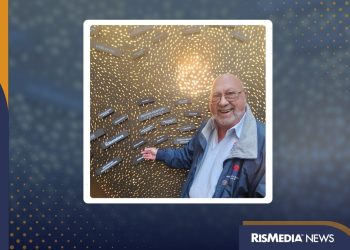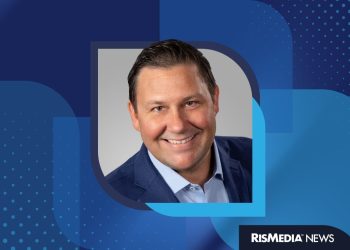


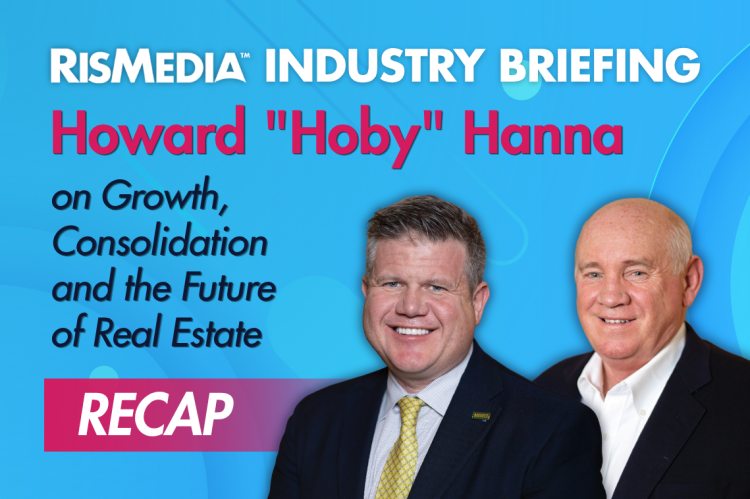
Above, from left: Howard ‘Hoby’ Hanna and John Featherston
Howard Hanna Real Estate Services has seen significant growth and expansion over its nearly 70 years in business, even amid the intense consolidation currently taking place in the residential real estate industry.
During the latest RISMedia Industry Briefing, RISMedia Founder and CEO John Featherston sat down with Howard Hanna Real Estate Services CEO Howard ‘Hoby’ Hanna to pull back the curtain on the company’s rich legacy, from its historic beginnings as a local independent firm to its current position as a regional powerhouse and emerging role as a national player. From game-changing acquisitions to bold moves through downturns, Hanna shared the strategic philosophy that has allowed the brokerage to expand to its current 15-state footprint.
“We’ve been fortunate with our growth,” said Hanna. “We’ve been aggressive, and we’ve been focused, and it’s been part of our overall strategy that started in the early 2000s to grow regionally. “We’ve had a lot of great folks that have come to us with a degree of trust…they know that their asset, should they give us the opportunity to acquire it, that we’re going to take care of it the way they did.”
From Smyth Cramer to Realty USA to Coach Realtors, Hanna underscored that the relationship-factor has been and continues to be critical to the firm’s acquisition success.
“A lot of those companies, we grew up in the business with them,” he said. “A secret to our success is that we’ve had a relationship with people. It’s not just all about numbers.”
Hanna pointed to 2008—when the firm acquired its largest competitor in the Cleveland market at the time, Realty One—as a defining moment in the company’s history.
“The real estate market was sort of quickly going to hell in a hand basket, and we made a big, bold move with a great company,” he explained. “As we shifted around the Great Recession and really built, not only in Cleveland, but Pittsburgh and other markets, that gave us confidence. As 2010 came around…we saw this next generation of family members and said, ‘Can we continue this? Can we grow even more?’ So we said, ‘Yeah, but we’re going to stick to a geography of adjacency.'”
In the ensuing years, Howard Hanna expanded further into Ohio as well as Michigan, New York and South Carolina. Opportunities continued to present themselves, Hanna explained, as brokerages looked for a culturally aligned, trusted firm to partner with.
“We haven’t had to grow for growth’s sake,” he said. “We don’t have to do another deal. But because of all the consolidation going on today, we think we’re a strong alternative for somebody who might be looking (to pass) their family business to somebody they can trust to build it in the right direction.”
Hands-on leadership is the cornerstone of success
The culture of trust, transparency and strong relationships that fueled Howard Hanna’s acquisition success is embedded in its leadership style as well, with Hanna and the firm’s executives regularly visiting local offices to connect with agents. He believes this type of consistent, face-to-face interaction is something many real estate leaders have gotten away from.
“Not to be critical, but the executives sort of are in that ivory tower,” he explained. “Agents need a plan, they need guidance, they need trust, they need leadership—but they need relationships and they need to be able to trust that you get it, that you get what’s going on in their life.”
Having sold real estate for three years before moving into a management role, Hanna can easily relate to agents.
“I still like to go on listing appointments with our agents,” he said, “because I get to hear the agent overcome the objections. I still like to take a look at the strategy of how we’re marketing. You’ve got to stay in tune with it. What happens in our business sometimes is management and leadership gets too far away from the street.”
Focused on the customer
Featherston stressed the importance of this “symbiotic relationship” Howard Hanna has with its agents.
“They understand that they’re not just working for an organization,” he said. “They have an organization that’s also working for them. The ultimate success of your organization is not just based on the home closing and getting a portion of the commission, it’s your essential services.”
Howard Hanna’s essential services—mortgage, title and insurance—are designed to streamline the consumer experience rather than just capture additional revenue, Hanna explained.
“We don’t go out and try to capture business from the competition,” he said. “We try to find a product that’s going to help our customers and therefore our internal customer, our agents, close more deals.”
According to Hanna, the company has about a 30% capture rate in mortgage and approximately 15% in insurance.
“We think there’s a lot of runway to improve, but it’s been very successful and we hope our agents see it as a value to them, as well,” he added
Change for the better
Given the rapid evolution currently underway in the industry, Featherston asked Hanna to describe his approach to navigating change—and seizing opportunities along the way.
“Some of the macro situations, we just have to deal with—we’ll always have to deal with them,” said Hanna. “I think that we just have to take more markets sometimes, take more opportunity, be smarter, work faster, work harder. That’s the tough thing about this business—because of the margins, it’s not one where you can just be lucky and ride the wave. It’s a hard-working business.”
Hanna also stressed that, historically, change has been for the better.
“Look at consolidation,” he said. “This industry probably needs some consolidation. We’ve seen a lot of different forces come into the business bringing capital, which usually improves it.”
Hanna highlighted the positive impact made when corporations like Merril Lynch and Prudential entered the residential real estate arena.
“When those companies came in, and they bought other companies and tried to consolidate, they also brought new professionalism, new training, new education, new technology. The water’s warm. Bring in some of that Wall Street money and capital money, and it may improve our industry as a whole.”
Featherston asked Hanna to comment on the consolidation and evolution happening in the MLS sector.
Hanna, whose firm utilizes 85 MLS feeds, lamented that the MLS has morphed into a commodity.
“I think that the MLS overstepped to try to do too many things for all people—to sort of be a commodity, a utility, not just an infrastructure between brokerage firms,” explained Hanna. “I don’t think you need 500 MLSs across the country. Could we just start with one MLS in each state, as opposed to having 50 or 40 or 20 in an individual state throughout the country?”
As the likes of Google and Anthropic follow portals like Zillow into the listings arena, Hanna emphasized the importance of data..
“The whole ecosystem starts with listings,” he said. “I don’t think the market was ever supposed to be that you could take my listings and monetize them and build your business.”
“I get passionate about this because I think we lost our way,” he added. “…we will lose the businesses to the portals, we will lose everything to somebody else as opposed to brokerage firms, and MLSs will be consolidated and they’ll be out as well, if we don’t re-look at the playing field—if we don’t look at the manmade rules and laws we put on ourselves.”
To address the continued friction around data, Hanna discussed the firm’s recent partnership with Ocusell to develop a proprietary platform, HannaList. He explained how the platform has increased traffic for the brokerage’s listings, and created a simpler input than most MLSs. It has also given Howard Hanna flexibility in how listings are marketed, including coming-soon strategies.
“The listings that are going through HannaList into our system with even one day or a weekend of exposure before the MLS—we’re seeing four times as many leads coming to the listing agent. We’re seeing SEO increase,” he explained. “The organic search through Google is increased because the point of origination is howardhanna.com, not an MLS.”
Ready for the future
Featherston turned the discussion to how Howard Hanna is adopting the use of AI, and what the technology means for the future.
While Hanna explained that the company is utilizing AI for compliance and CRM- and propensity-based marketing, he emphasized that AI will not replace the agent, and the human touch will be more important than ever.
“Our industry has to be careful with AI,” he said. “As we test it, we still have to have the human touch.”
When discussing AI, data and IDX, Hanna pointed to what he characterized as mistakes the industry has made in terms of creating, protecting and amending rules surrounding these topics, and what the vision for the future should look like.
“I think we either come together and coalesce with what the playing field needs to look like today, or somebody will make the decision for us on the outside, a third party,” said Hanna.
As a third-generation CEO with more than 15,000 sales associates, with plans to announce two acquisitions in two new markets this summer, Hanna shared what it will take for the firm to continue to thrive into the future.
“We’ve got to be nimble in the local markets that we’re in and improve and stay focused in leadership,” he explained. “Not growth for growth’s sake, but to make sure that you’re creating a great environment for the consumer, the agent and the people that work for you.”
For more information on growth, consolidation and the future of Howard Hanna Real Estate, check out the full webinar here. Hear more from Hoby Hanna during his presentation at RISMedia’s 38th Annual CEO Exchange, September 30 – October 2 in Washington, D.C.
To view more webinars from RISMedia, subscribe to our YouTube channel.