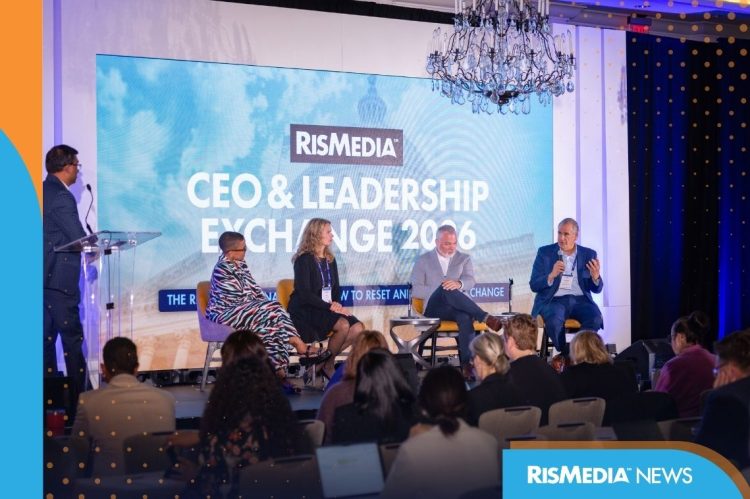
Above, from left, Rajeev Sajja, Marki Lemons Ryhal, Amy Gromowski, Matthew Rathbun and Charles Oppler
WASHINGTON, D.C.—Real estate brokerages can’t treat AI as a shortcut, or they’ll expose their agents and companies to untold risks, a panel of industry experts said during RISMedia’s 38th Annual CEO & Leadership Exchange on Oct. 1.
AI was the word on virtually everyone’s lips during the three-day conference, especially during the panel discussion, “Taking the Risk Out of AI.” The four-person panel delved into the risks AI poses and how brokerage leaders need to account for those risks to safeguard listing data and consumer trust.
As the capability and speed of AI scales faster than anyone can keep up with, brokerage leaders can’t afford to wait for government regulation or industry associations to act, the panelists agreed.
AI fluency, competency
While AI undoubtedly can lead to operational efficiencies for agents and firms, there’s a difference between putting AI tools in the hands of a competent agent—and in the hands of someone who passed their licensing exam, said Marki Lemons Ryhal, chief artificial intelligence officer with ReMarkiTable.
Lemons Ryhal pointed out that if an agent doesn’t have competency with AI, that’s not an excuse; brokers ultimately shoulder the responsibility for every aspect of a transaction, including how their agents use AI to handle customer and listing data.
“That means that we, as the company owners and as brokers of record, we have to be responsible and engaged,” Lemons Ryhal said. “We have to come up with criteria and rules of definitions, but we also need to give the foundational information that our real estate agents are feeding into the different AI platforms.”
Panel moderator Rajeev Sajja, chief AI and product officer with Bright MLS, added that competency also relies on AI fluency. And that requires the right training.
“(Agents have) not really gotten fluent with leveraging AI to amplify their thinking versus just using it as a fast track to get where they need to go,” Sajja pointed out.
Removing AI’s risks in real estate
At Cotality, the real estate data and analytics giant, AI is embedded within multiple products the company offers to the industry.
That is according to Amy Gromowski, Cotality’s vice president and head of Data Science, who noted that brokerages have to identify someone within their organizations who is responsible for AI policy and assure they understand data lineage to ensure responsible usage.
Before you consider any vendor or tool, you have to ask the right questions, such as what data is going into it, what’s the source of truth for the data and how does the vendor manage the data and ensure coverage completeness, Gromowski said.
“AI is only as good as the inputs going into it, so that’s the first goal,” Gromowski told nearly 400 of the nation’s top real estate leaders in attendance. “If there’s complexity to that data, how are they joining it and linking it? What kind of quality control do they have around them understanding it?”
Policy is only as strong as trust
With the speed of AI adoption and usage, brokerages need clear AI policies in place, according to Matthew Rathbun, executive vice president of Coldwell Banker Elite based in Fredericksburg, Virginia.
But it shouldn’t stop there, he added.
“Your leadership skillset is the real enforcer of AI policy,” Rathbun said. “If you don’t understand the tool, you can’t write a policy that properly enforces minimum standards at your company.”
For example, agents should never use free chatbot tools; otherwise, any confidential data they input into those tools will be used to train large language models, Rathbun explained.
Ensuring your agents understand the seriousness of protecting client data starts with brokerage leaders who have earned trust. And if agents don’t trust their broker to be “their source of truth” and to protect them from AI-related risks, any policies you create will be irrelevant, he added.
When Sajja asked how many leaders in the room already had AI policies, only a few hands went up. But he pointed out that having a policy only tells people what they can and cannot do, but not how to actually use the tools.
Another way to build trust with agents is providing them with the right technology stack and education on how to use it effectively, according to Charles Oppler, managing partner and CEO of Prominent Properties Sotheby’s International Realty based in Franklin Lakes, New Jersey.
Oppler noted his firm has more than 800 agents who’ve been with his company for 15 to 25 years, and “trust is first and foremost.”
“When we bring them a product, right from the beginning, they think we’ve done the research,” Oppler said.
Keeping the human in the loop
When asked how brokerage leaders can avoid losing the human connection as AI touches more aspects of their businesses, the panelists agreed that AI should never replace the personal relationships the industry prides itself on.
“We are all saving hours every single day by leveraging artificial intelligence,” Lemons Ryhal said. “Anything that is client-facing must have a set of human eyes on it before you share it with the world.”
Sajja added, “Just because AI can, doesn’t mean AI should. AI has a lot of value, but humans are the real value.”
Rathbun points out that AI should be viewed as an efficiency tool, not a replacement tool. Brokers need to teach their agents the “how” first before introducing tools to help them execute tasks with AI.
With recent news about AI’s growing security issues, some brokers might feel reluctant about using AI and pause implementation, Rathbun said. However, that inertia could hurt their business in the long run, he cautioned.
“Good luck recruiting and retaining” if you’re not using AI, Rathbun said. “I don’t think that’s a winning position.”