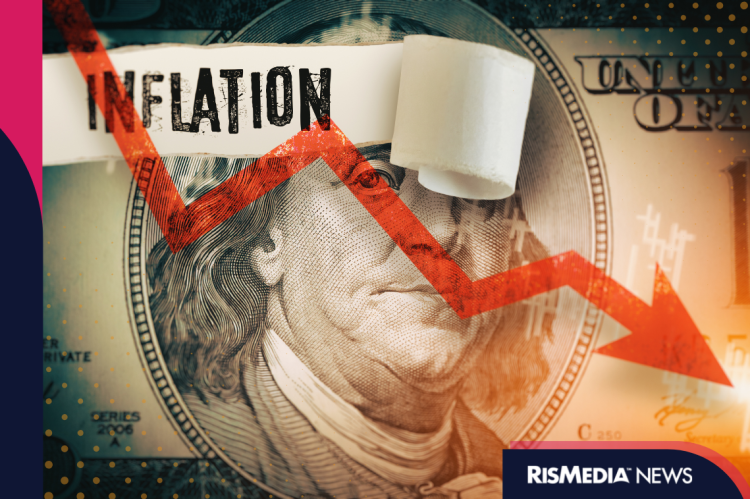
Across the first half of 2026, numerous economic reports revealed high or rising inflation. Some officials of the Federal Reserve, which remains focused on bringing inflation down, have suggested that interest rate hikes could be necessary if inflation does not fall. The latest data from the Consumer Price Index (CPI), maintained by the U.S. Bureau of Labor Statistics, could make this scenario less likely.
The latest CPI found that annual inflation decreased month-to-month on a seasonally adjusted basis by 0.4% in June 2026, up 3.5% year-over-year.
This is also greater than expectations for inflation, with the finance sector having expected a 0.2% monthly decline with a 3.8% annual inflation reading. Notably, this also marks a stark turnaround from the previous CPI reading, which was described at the time as the “highest headline CPI reading in three years,” by Realtor.com® Senior Economist Jake Krimmel.
A drop in housing inflation has been reported as one driver, with shelter services posting only a 0.1% monthly inflation increase for a 3.3% annual reading. This represents the smallest monthly gain for shelter since January 2021, as noted by Krimmel.
The larger driver of the drop, though, was energy inflation, specifically a 9.7% monthly drop in gas prices.
“Core CPI, the more important number that excludes volatile food and energy, was flat month-over-month, while the annual rate came in at 2.6%,” Krimmel noted to underline energy inflation’s impact. However, he also noted that the core inflation reading was a monthly drop from 2.9%, and that this reading also “beat expectations.”
“For consumers and homebuyers, this is good news on two fronts: inflation is falling, and the report removes one source of upward pressure on mortgage rates in the near term,” said Krimmel, pointing to mortgage rates that have “hovered around 6.5%” in recent months and which rose slightly to 6.49% last week.
“Today’s data, combined with the drop in Treasury yields, may point toward some relief rather than the renewed instability the market had been bracing for. That matters heading into the traditionally slower but still-active late-summer buying season,” Krimmel said.
However, Krimmel also cautioned that this CPI reading is not necessarily the beginning of a consistent new trend.
“This is just one report and things change quickly,” said Krimmel. “With the Middle East ceasefire fragile and energy prices historically volatile, the durability of today’s relief will depend on whether core inflation keeps cooling in the months ahead, not just this one.”
What the CPI could mean for interest rates
Following the June jobs report finding a weak labor market, Krimmel said it was unlikely that this would move the Fed’s decision-making on monetary policy, where inflation is currently seen as the more pressing issue. This CPI reading could be a data point in favor of not raising rates for the time being.
Krimmel, who predicted the Fed will choose to keep interest rate changes paused at the next Federal Open Market Committee (FOMC) meeting next month, cautioned that “one soft reading does not settle the inflation question (…) Two data points from May to June don’t constitute a trend for the FOMC.”
Krimmel also cited a July 13 speech by Christopher Waller where Waller said his focus remains on inflation—specifically core inflation—rather than the labor market, and that he would “need to see several months of lower readings to feel that inflation is moving in the right direction.”
Moreover, while the CPI measures inflation, the Fed favors the parallel Personal Consumption Expenditure (PCE) index maintained by the Bureau of Economic Analysis. The June 2026 PCE report found the highest annual increase in inflation since 2023; it remains to be seen if the upcoming next report, scheduled for Thursday, July 30, will corroborate the inflation findings of the CPI.
For the full release, click here.