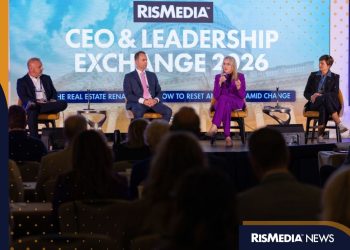
Above: Keller Williams’ Mega Camp (photo courtesy of Keller Williams)
Consumers aren’t spending that much. They aren’t confident in their earnings. They aren’t looking for jobs.
Yet real estate keeps chugging along, Keller Williams Co-Founder Gary Keller noted in a speech to the company’s agents yesterday, in which he focused on the macro picture, including an uncertain road for rates and the federal government’s attempt to take advantage of “wiggle room.”
Speaking at Keller Williams’ “Mega Camp” in San Antonio, Texas, Keller argued that overall, things should be a lot better for housing—and maybe the economy more broadly—blaming what he claimed was a tendency of new presidential administrations to overstep when the country is in a good place.
“We thought that we would be on this stage today, and we would be announcing that interest rates were coming down,” he said.
Looking at broad macro trends, Keller noted that home sales are once again on track to come in slightly above 4 million in 2026, well below historic averages, despite an economy “set up beautifully” in 2025. Rates are unlikely to fall anytime soon, and the labor market appears mixed at best, according to Keller.
“Never underestimate the willingness for the government, when things are good, to make them bad,” he said. “That’s not political. That happens on both sides of the aisle. I’m just saying that when things are really good and a new administration comes into power, they immediately believe that they have wiggle room to go and run policy.”
Real estate economists have pointed to wildly inconsistent tariffs and the ongoing war in Iran as heavily weighing on economic structures that power the housing market, from new builds to rates to inflation. In the long-term, President Donald Trump’s near total shutdown of immigration is also expected to have negative impacts on housing.
Keller said that in 2025, when housing was “set up” for lower rates, all the new administration needed to do was “no weird government policies…and the price of money will come down.”
“If you’re elected, you were elected on certain issues. But you have to pay attention to the economy—it’s all about the economy, stupid,” Keller said, paraphrasing political strategist James Carville.
Buyer/seller blues
For consumers, Keller claimed the issue is still often one of psychology.
“So buyers think it’s 2008, sellers think it’s 2021. Yeah, I’m still 25. Nobody cares. It is what it is, guys,” he said.
The broader outlook for consumers centers a lot on the labor market, where Keller said that low unemployment belies a more uncertain labor market outlook.
“That’s normally great. And in 2023-24, it felt great. But then hiring started to slow down. Policies changed. And now it just feels sort of stagnant,” he said.
“Anemic” increases in jobs along with lower labor force participation and wage growth all contribute to a “weird” situation, according to Keller. Inflation is also cutting into household budgets, in essential areas like groceries.
What does it mean for buyers and sellers?
“It depends on what income level you live at,” he said.
Keller briefly waxed philosophical, wondering why “the people that make the most amount of money get to make the decisions for the people that make the least amount of money”—a question that other Keller Williams executives on stage did not have an answer to.
Practically, Keller brought it back to the long-term stable wealth building of real estate—something that he claimed could apply even to those on the lower income levels who worry about tight housing budgets and rising costs.
“People always make the argument that, ‘Yeah, but if I pay rent, I’d be paying a little cheaper, and I have that money.’ But you wouldn’t invest that money,” he claimed. “If your income doesn’t get better in 30 years, the home will be paid off and it’ll be cheaper than renting. It’ll be cheaper.”