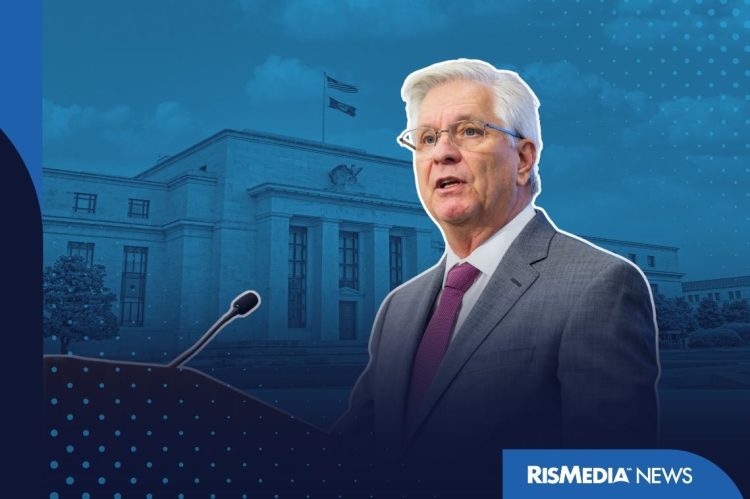
Above, Fed Governor Christopher Waller
As the Federal Open Market Committee’s (FOMC) next meeting quickly approaches, real estate professionals are closely monitoring Federal Reserve governors for any hints as to whether rates will remain the same or face increases.
At Reuters NEXT Newsmaker Interview Thursday, Fed Governor Christopher Waller described his economic outlook and stated that “recent data suggest we are finally seeing some signs of disinflation.”
In his speech, Waller illustrated the current state of the economy as stable, citing labor market trends as his main measurement for how current policies are “working to return inflation to 2%.”
“Turning to the labor market, it is also in satisfactory shape. While there were indications in the second half of 2025 of easing labor demand, relative to supply, those signs evaporated,” he said. “Job creation, though a bit volatile, has increased this year by an average of 60,000 a month through July. That is close to and probably a bit above estimates of what it takes to keep pace with the slow growth in the labor force—mostly because of much lower net immigration.”
Currently, inflation sits at around 3.7%, nearly double the Fed’s goal and has remained elevated for five and a half years, according to Waller. After the Personal Consumption Expenditures (PCE) price index report for July was released, economists speculated whether the Fed’s “wait-and-see” approach would succeed in reaching their goal.
Mortgage rates have also seen little fluctuation, according to Freddie Mac’s Aug. 27 Primary Mortgage Market Survey®. Rates have remained within the upper-mid 6% range, with economists fearing how geo-political conflicts and tariffs could leave their impact.
Waller noted that depending on the results of tomorrow’s jobs report by the Bureau of Labor Statistics (BLS), he may be inclined to support holding interest rates or raising them.
“If this continues in the data due over the next two weeks, I would be inclined to support holding the target for the federal funds rate at its current setting,” he said. “But there continues to be considerable uncertainty about how military conflicts, trade policy and artificial intelligence will affect prices and economic activity. If the incoming data for August show this improvement has been fleeting, then it may be appropriate to raise the policy rate when the FOMC meets on Sept. 15 and 16.”
Fed Governor Michael S. Barr echoed a similar sentiment in his speech at the Second Chance Lending Forum on Tuesday. There he focused on low unemployment and the power of AI in the labor market. But—just like Waller—he cautioned that tariffs and conflicts in the Middle East could place significant pressure on inflation’s pace.
The BLS’ employment report for July reported a decrease of 23,000 payrolls, and included downward revisions of previous months. But economists and Fed governors await the results from tomorrow’s employment report, which will reflect data for August.
Although Waller seemed hopeful, he noted that he is prepared to consider the consequences of elevated energy prices and foreign affairs.
“I do see some upside risks to inflation. Energy prices have moved up again and remain significantly higher than they were at the beginning of 2026, and the economy faces both pressure on technology goods prices related to the AI buildout and the possibility of more tariff increases,” he said. “But, in contrast to the period of high inflation after the pandemic, wage growth—once one accounts for productivity growth—is broadly consistent with an expectation that inflation is continuing to come down to 2%.”
Both Waller and Barr stated in their speeches that should economic trends show no clear path toward the Fed’s 2% goal, they would be inclined to raise rates. On the other hand, Fed Chairman Kevin Warsh made clear that any monetary policy stances he takes will be kept close to the chest in his first Jackson Hole speech last Friday.
Currently, Waller agreed with Warsh’s sentiment on forward guidance, but he noted that he believes forward guidance does have a place within the Federal Reserve.
“I agree with Chairman Warsh that forward guidance isn’t appropriate now or in many other situations. But when it is truly needed, I believe it should be used,” he said.
On his own future monetary policy decisions, Waller described his decision-making process as a “reaction function” and will base his judgments on the data provided.
“I view myself as a home plate umpire in baseball. The pitcher is trying to strike out the batter, and the batter is trying to hit the ball or walk to get on base. Both want to play the ball, but they cannot do that until they know the umpire’s strike zone. The strike zone is the umpire’s reaction function,” he continued. “The players don’t expect the umpire to have a perfect strike zone—they just need a rough idea of its parameters and some guarantee that it won’t change much on every pitch. Perfection is not needed for them to play well. So, when it comes to my reaction function, I do not let perfection become the enemy of the good.”