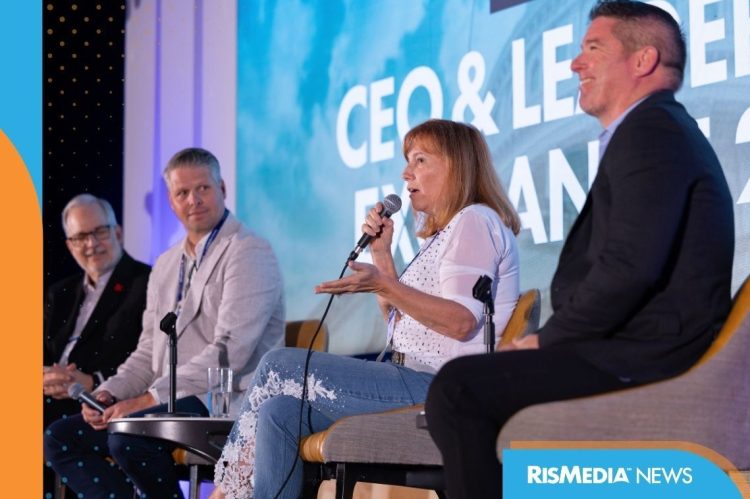
From left, John De Souza, Christopher Pfeiffer, Dawn Pfaff and Donny Samson. Photo by AJ Canaria.
WASHINGTON, D.C.—The real estate industry is feeling more like a landmine right now, with professionals carefully navigating internal and external forces that threaten their businesses. But where some see potential threats, others see opportunities—even as market uncertainty and bitter litigation proliferate.
During a panel discussion aptly titled “Next Threats: How to Identify and Prepare for Future Risks,” several panelists shared which issues keep them up at night and how they’re responding to them at RISMedia’s 38th Annual CEO & Leadership Exchange Sept. 30-Oct. 2.
From consolidation to industry in-fighting to AI and fierce litigation, there’s no shortage of issues that could become bigger threats to real estate brokerages. But there’s also a lot of noise that’s become a distraction, panelists agreed.

Consolidation, fragmentation and other emerging threats
John De Souza, president of Cressy & Everett Real Estate, which operates in Indiana and Michigan, pointed to consolidation concerns, particularly for smaller operators who “are going to get squeezed out” as larger brokers acquire smaller competitors amid shrinking margins and tough competition.
“Today, we have anywhere from 30% to 40% of all licensed agents working under one of those (consolidation) structures,” De Souza said. “We know that those mergers need to have cost savings because that’s how the whole thing came together. They’re going to be working on their tech stack. They’re going to consolidate because it can help pull these savings out.”
On the other hand, CEO Donny Samson of Virginia-based independent Samson Properties, is most worried about what he views as the threat from within: Fragmentation.
“The prioritization of our data and what’s best for the consumer has been lost,” Samson said. “What’s best for our company or our stock price just becomes a bigger and bigger battle. We are losing the trust of the people, of the public, because we can’t get along with each other—and it hurts our industry. We can stop fighting each other.”
When asked about the battle over off-market listings, Christopher Pfeiffer, managing partner with Comey & Shepherd Realtors®, a mid-sized independent brokerage serving Kentucky and Ohio, pointed out that off-market listings make up just 5% or so of the overall market. “I view that as a small risk,” he said. “But the bigger risk is that we’ve got 700,000 or 800,000 real estate agents that don’t do very many transactions a year.”
In addition to the number of unproductive part-timers in the business, Pfeiffer pointed to dual agency as another problem leaders need to keep their sights on. Both issues, he said, should be addressed to better “represent the consumer in the best possible way and protect someone’s fiduciary responsibility.”
Disagreements on AI, off-market threats
When the panel turned to the elephant in the room—whether AI will replace agents—opinons diverged sharply.
While some in her industry are pushing for more AI regulation, Dawn Pfaff, founder and president of My State MLS, isn’t of the same mind. She called the worries over AI “hype” and claimed that “the people who are making the rules at the MLS, they want to keep the positions that they have, so they go towards regulation.”
Throughout the conference, various leaders were emphatic that AI will never replace human relationships in real estate. But De Souza didn’t hold back in his dissent, sharing a warning.
“I think we need to stop saying that AI won’t replace our agents; that’s short-sighted,” De Souza said. “I’m not saying that it’s going to replace all of our agents; I’m saying it’s going to replace some of our agents.”
Still, brokerage leaders need to proceed with AI cautiously because “it’s made everyone more litigious,” Samson said. “AI is making everybody a lawyer,” he added, noting that it’s another threat to the business if someone thinks they’re being wronged simply because AI said so, resulting in frivolous lawsuits.
Regarding off-market listings, Samson noted that markets with a higher share of luxury listings are likely under a bigger threat if off-market listings dominate. He agreed with Pfeiffer that the barrier to entry and to stay in real estate is too low. That, along with in-fighting, is “destroying” the industry, he said.
Preparing for the future
Each panelist offered their best advice for facing current threats as leaders look to the year ahead.
De Souza emphasized that unless agents double-down on delivering a customer service experience better than what an AI tool can offer, “not everybody’s willing to pay for relationships.”
“Get serious about experiences,” he said.
Pfaff said she believes that “competition in the free market” is the way forward to give consumers more choice, and they will decide which business models should survive.
While Pfeiffer doesn’t think AI will necessarily replace agents, “it’s just going to expose mediocrity.”
Samson urged leaders to help their agents get back to basics and keep their people engaged through training and retention. He acknowledged agents have a lot of fear over AI and market conditions, so brokerage leaders “need to be positive with their agents” and “help them be more successful tomorrow with what we’re learning in these rooms,” he said.