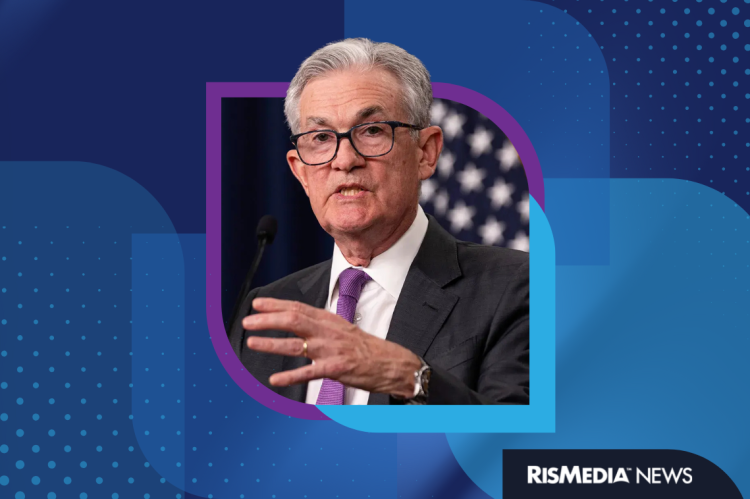
Above, Fed Chair Jerome Powell
The Federal Reserve has announced its interest rates will remain unchanged during its Jan. 28 meeting. This follows three straight rate cuts from the prior three Federal Open Market Committee (FOMC) meetings of 2025.
The FOMC announced at its first meeting of 2026 that it has kept interest rates at 3.5%-3.75%. This follows a 25-basis-point cut in December that brought the rate from a range of 3.75%-4.0% to a range of 3.5%-3.75%.
“We began cutting in September of 2024…and we think we’re well-positioned here to watch how the economy performs, look at the data,” Federal Reserve Chair Jerome Powell noted. “We’re not making decisions about future meetings, but we do think we’re well-positioned after those three cuts to let the data speak to us.”
There were two dissents, with Stephen I. Miran and Christopher J. Waller voting to lower the target range for the federal funds rate by a quarter percentage point.
Even among non-voters, the committee pretty broadly agreed on holding, Powell said.
“There was broad support on the committee for holding today, I would say, including among non-voters. Of course, some people did want to cut and dissented, but the committee pretty broadly (agreed) for holding today.”
MBA SVP and Chief Economist Mike Fratantoni commented on the fragmented decision.
“While not a unanimous vote, there does seem to be a clear and consistent majority in favor of a pause in this rate-cutting cycle, a pause that likely continues unless or until the job market weakens further,” he said. “With inflation remaining elevated, the FOMC majority does not seem in any rush to make further rate moves.”
Powell noted that 2026 has kicked off on a solid footing, and there is an overall stronger footing, based on the data.
“The economy is growing at a solid pace. The unemployment rate has been broadly stable, and inflation remains somewhat elevated,” Powell said. “So, we’ll be looking to our goal variables and letting the data light the way for us.”
Powell’s assessment of the labor market revealed a more nuanced picture. While the employment rate has stabilized at 4.4% in December, job growth has remained sluggish. Total non-farm payrolls declined at an average pace of 22,000 per month over the last three months, though private payrolls rose at an average pace of 29,000 per month when excluding government employment.
According to Powell, much of the recent slowdown reflects broader shifts in labor supply rather than weakness in demand alone.
“A good part of the slowing in the pace of job growth over the past year reflects a decline in the growth of the labor force due to lower immigration and labor force participation, though labor delay softened as well,” he noted.
Powell addressed whether the Fed might resume rate cuts or even consider hikes in the coming month.
“We’ll always be looking at both things. And so there could be combinations, infinite numbers of combinations, that would cause us to want to move,” he said. “Certainly, a weakening labor market would be an argument for loosening. But what’s happening with inflation? If inflation were at the same time getting worse, you just have a very difficult situation there. So we’ll be looking at both. Clearly, a weakening labor market calls for cutting. A stronger labor market says like that, the rates are in a good place.”
When asked for his advice to the next Fed chairman, given he only has two more FOMC meetings left as chair, Powell gave the following token:
“Stay out of elected politics…Another is that…our window into democratic accountability in Congress, and it’s not a passive burden for us to go to Congress and talk to people; it’s an affirmative, regular obligation. If you want democratic legitimacy, you earn it by your interactions with our elected overseers…It’s something you need to work hard at…I will tell whoever it is, ‘You’re about to meet the most qualified group of people…you will ever work with…and when you meet Fed staff, not everybody’s perfect, but there isn’t a better cadre of professionals more dedicated to the public wellbeing than work at the Fed.”
During the press conference after the meeting, Powell was asked to respond about attending oral arguments at the Supreme Court hearing last week examining whether President Trump can fire Fed Governor Lisa Cook and Treasury Secretary Scott Bessent’s criticism of his attendance as being political. Powell stated he doesn’t think it’s appropriate to respond to comments made by other officials but said he attended because, “That case is perhaps the most important legal case in the Fed’s 113-year history and as I thought about it, I thought it might be harder to explain why I didn’t attend…it’s precedented and I thought it was an appropriate thing and I did it.”