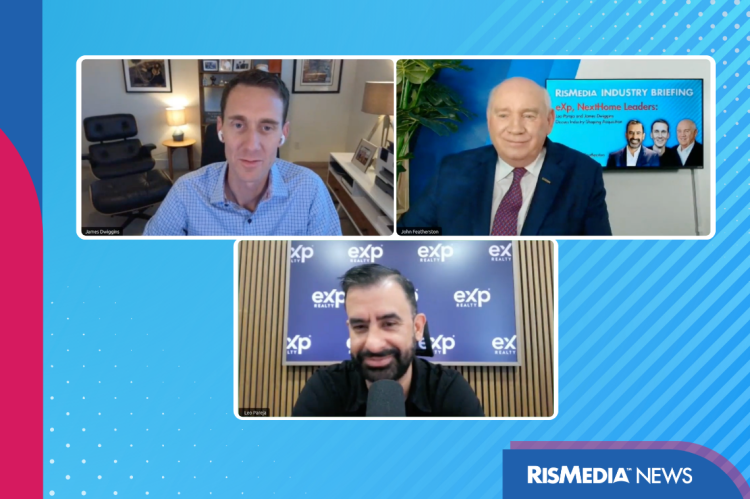
Above, from left top row, NextHome President James Dwiggins and RISMedia Founder and CEO John Featherston; bottom row, eXp CEO Leo Pareja
When the leaders of eXp Realty and NextHome came together for an RISMedia Industry Briefing webinar to discuss the former acquiring the latter, the talking points with RISMedia Founder and CEO John Featherston moderating were many. While the business deal was top of mind, the industry is also facing unprecedented change, and the leaders of both brokerages remain outspoken thought leaders on many of the hottest topics—from private listings to technological disruption.
The conversation situated the acquisition within broader industry upheaval, including private equity-driven consolidation, ownership changes at major brands and ongoing litigation and regulatory shifts, which are driving agents and franchisees to reassess alignment on transparency, leadership and consumer treatment. eXp’s Leo Pareja and NextHomes’ James Dwiggins agreed that the next three to five years will bring significant change, but maintain that 4-7 million Americans will continue to move annually, preserving demand for professional guidance even as technology and AI automate routine tasks.
Pareja and Dwiggins went in-depth on some of the major reasons they felt a joining would be beneficial to both companies.
Offices and cloud-based brokerages
The companies have totally different operational procedures, with eXp fully cloud-based and NextHome with over 500 physical offices across the U.S. and a major emphasis on culture. The ability to become both was a big reason why they were drawn to each other.
Dwiggins asserts that regardless of office vs. cloud, all that matters is performing all-out for the consumer
“Are you putting their best interests forward?” he asked. “Are you looking out for them? Are you doing the things that are right for buyers and sellers in America? We are aligning to take that stand, and we’re obviously attracting a lot of people into our organization that view that. Brick and mortar is something that people still want, in some cases. In small towns, people like to go in and hang out at the office. So we’re simply opening up this multi-model channel to have the ability to attract people in.
“It’s about meeting the agent at the point in their career where they’re at. If they’re wanting to get to the point of being a broker and doing their own thing, we now have a platform for that. If they’re at a point where they want to just operate or recruit agents and create a downline, we have that platform. We are pushing very heavily to keep overhead down because that’s one of the margins that you can control.”
Featherston wondered how AI would affect the consolidation of eXp and NextHome. Pareja acknowledged that AI has caused a transformational moment in society.
“I saw a post the other day that said people are using AI for the sake of using AI versus having a problem and then asking, ‘Is this automation? Is this AI? Is this a workflow? Is this an SOP (standard operating procedure)?’” he said. “Where AI is giving great results is on highly repetitive tasks, which at our scale we do a lot of them. In the last 12 or 18 months, the dramatic improvements on workflows and processes have all been back of the house, and that’s the interesting lift that we think we’ll provide to NextHome.”
Agents as key players
Featherston said an agent’s potential loss of stature in the eyes of buyers and sellers is “the greatest threat to our value going forward as an industry.
“What can you be doing better to keep the agent as the center of the transaction?” he asked.
Dwiggins didn’t hold back. While reminiscing somewhat about the good old days when MLSs pretty much ruled the residential real estate market, he nonetheless admitted that while he wasn’t thrilled with how business has evolved over the last few years, he was determined to guide NextHome’s agents and employees into continued profitability, and that meant joining forces with a bigger player like eXp Realty.
“The industry doesn’t understand the chess game being played,” he began. “We have the greatest system ever developed with the multiple listing service, and it’s under a massive threat. MLSs are being postured and positioned to benefit certain ideas that I don’t agree with. I think they’re caving in the direction of what’s happening because they can’t stand up for what’s right for the consumer.
“Private listings are a massive threat to the industry in so many ways. You’re going to see five or six large companies, us being one of them candidly, that will play in this game and are going to control inventory. This is the world that we’re facing right now. I think it’s a scary thing from a consumer perspective. We built a system that is so good that sellers get maximum exposure and buyers can find what’s for sale without having to have secret handshakes and knowing the right person to call.
“One of the reasons that we are affiliated with eXp is because of their size. If this is the world we’re going to play in with private listings, then I want to be aligned with a company that has a hell of a lot of inventory.”
Pareja talked about how the U.S. system for homebuying and selling differs quite dramatically from some other countries, where real estate monopolies exist with agents on the lower end of the totem pole.
“It takes six months to sell a house in the United Kingdom,” he noted. “The process is completely different because you don’t have this one highly incentified human being making sure it gets there, or actually two driving the process forward.
“We will always do what’s best for the consumer, and also help our agents win. It’s not the other way around. We want to be aligned with agents who believe in being fiduciaries, representatives of their customers and clients and making sure that they’re delivering a high value of service. The risk of all this is additional litigation, DOJ investigations and fair housing violations.”
More AI, fewer agents
Featherston reminded Dwiggins about his recently predicting a loss of agents going forward. “Do you see that accelerating because of the market conditions today and technology and the consolidations that we’re witnessing now?” he asked.
The NextHome president said he hoped he was wrong to some degree and not wrong to another, stressing that the industry in his opinion would become more professional, with only those truly devoted to it remaining. And that teams would increase over solo agents.
“I was looking at a study where team productivity increased by 400% versus the solo agent only increased by like 19%,” he said. “That should be a very strong sign of the fact that deals are rolling up more and more under large teams, which both we and eXp are known for.
“You have flex partners like Zillow which only work with teams. It’s very clear that that business model is continuing to grow. It’s a way for new entrants into the space to be able to get some business by working for a team. They get fed deals and can start to figure out how to get into this career because it’s expensive to get into if you don’t have reserves, it’s hard to make it in this business. AI is going to push on margins long term. The more efficient companies are positioning themselves correctly.”
Leo Pareja and James Dwiggins will attend RISMedia’s CEO & Leadership Exchange, set for Sept. 30 through Oct. 2 at Washington, D.C.’s Fairmont Georgetown Hotel. Join top brokers, executives and innovators for high-impact strategies, candid conversations and forward-looking insights designed to help you reposition, rebuild and outperform in the next phase of the market. For more information and to register, click here.