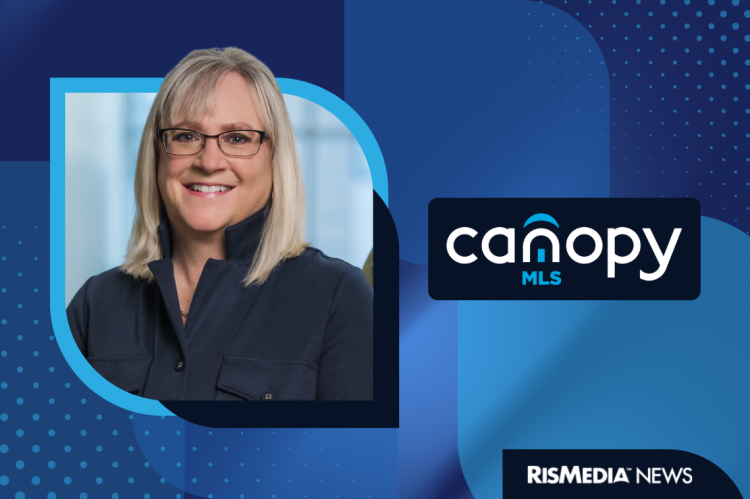
Above, Canopy MLS CEO Anne Marie DeCatsye
With the recent news that Charlotte, North Carolina-based Canopy MLS is joining the trend to expand nationally, Anne Marie DeCatsye, Esq., CEO of Canopy MLS, explained in further detail to RISMedia its recent move to allow subscribers nationwide.
The MLS serves 14 Realtor® associations and 26 counties in North and South Carolina.
DeCatsye says these changes emerged from board discussions about national industry developments, leading directors to take a closer look at artificial geographic boundaries beyond the current two-state footprint, with bylaw and membership-processing adjustments potentially implemented within a few months.
In parallel, Canopy is expanding its framework to allow brokerages to submit listings through approved third-party or proprietary systems, enabling firms to better leverage existing technology investments while maintaining standards for accuracy, compliance and data integrity.
DeCatsye says these initiatives are building on Canopy’s longstanding emphasis on innovation—illustrated by its adoption of a coming-soon status in 2016—and its strategy of closely aligning MLS policy and operations with evolving brokerage models while demonstrating MLS value to brokers large and small.
In a recent interview with RISMedia, DeCatsye shared more details on the major points.
Michael Catarevas: How specifically does the participation model work for real estate professionals across the country? What is the pricing, terms, etc.?
Anne Marie DeCatsye: We will be enforcing our current participation rule, which means in order to be a subscriber, the member participant has to belong, their broker has to belong. We’re not changing that. Some MLSs require the whole firm or office to join. We will only require that the participant and the subscriber join if they want to join Canopy. And I don’t see us charging anything different than we already do now.
MC: What kind of feedback or conversations with members led to the updates?
AMD: We spend a lot of time educating our board of directors and talking about current events and industry topics. We really had a good conversation about what’s going on to the extent we can understand it, and kind of filtering through what we see in the media and what we’ve heard outside. That’s what prompted the board to at least look at artificial boundaries. It’s not going to happen overnight. We have to modify our bylaws and make some adjustments in how we process membership, but it’s not a huge change for us. I would think in the next couple months that would be functional. Boxing ourselves into two states didn’t make sense when so many brokers have a national footprint or a mega-regional footprint.
MC: How do you feel about the debate over days on market or price drops data currently playing out across the country?
AMD: Days on market is still a frustrating subject because even if we don’t track it in the MLS, the syndication sites are tracking it as days on their site, and then even if we didn’t track days on market and pre-marketed listings, there’s going to be members who track it because they’re looking every day so they could come up with a system of tracking price changes. So any way you cut it, it’s going to be confusing to the consumer because there’s no consistent definition of days on market, and I don’t think there ever will be.
MC: Thoughts on pre-marketing?
AMD: On the one hand, we feel like in a pre-marketing status the seller should be able to test out a price without being penalized before it goes to market. But then on the flip side, if someone’s watching a listing in that pre-marketing status, they could figure out what the price changes are, and is it really fair? So this is something internally we are still discussing. We did make a decision, but we’re still looking at whether it was the best decision. Is it fair to withhold something that can actually be tracked? That’s going to be a discussion at the next board of directors meeting.
MC: Could you have anticipated five years ago where the industry would be now, and the things that you were having to do with Canopy to make sure you’re on the cutting edge?
AMD: That’s an interesting question because when you think about it, five years ago we were still in that second year of COVID, which was just a really weird time. Canopy enacted a coming-soon status in 2016, and we’ve had a coming-soon status for over 10 years. It’s kind of mind boggling to me that I’m finding out now that so many MLSs either don’t have a coming-soon status or they don’t distribute the data in the coming-soon status. So I feel like in that situation we were ahead, and this is somewhat of a natural progression. We pay a lot of attention to what our brokers are saying, large and small. So I’m not totally surprised, especially seeing how the brokerage models have changed in the last 10 years. I do think MLS policy and MLS operations need to catch up to the brokerage changes that have occurred. And in doing that, the MLS really needs to not just define its value proposition but demonstrate it clearly.