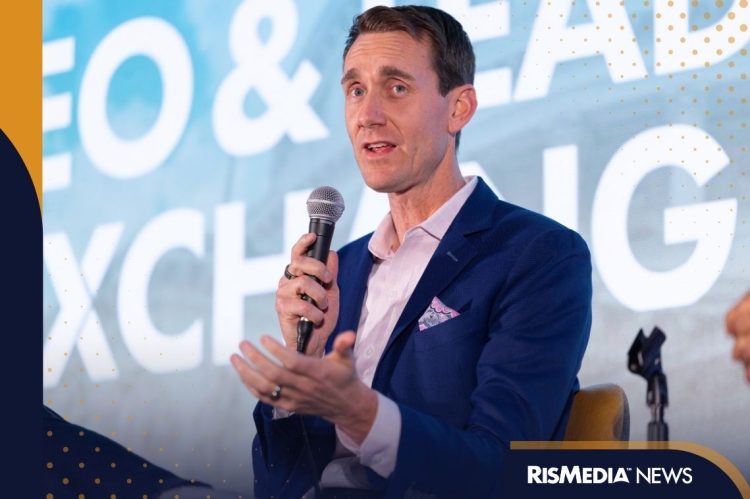
Above, NextHome President James Dwiggins at RISMedia’s 38th Annual CEO & Leadership Exchange. Photo by AJ Canaria.
WASHINGTON, D.C.—Real estate has always been a competitive industry, but other brokers aren’t your biggest threat.
That’s according to panelists at RISMedia’s 38th Annual CEO & Leadership Exchange who sounded the alarm that decision-makers should direct their energy to more existential threats.
James Dwiggins, outspoken president of NextHome, candidly called out how industry fragmentation from within—particularly the ongoing legal battle over listing policy—could have lasting consequences for housing.
“When I think about the competitive landscape, we talk about tech…and all this stuff that we’re doing in AI, and I get it,” Dwiggins said. “But I think that’s secondary to the architecture of how (real estate) operates in this country, and that’s under threat.”
Dwiggins’ direct warning came during Thursday’s first panel, “Understanding and Winning Against the New Competition.” He was joined by moderator Cory Vasquez, president and chief marketing officer of Realty ONE Group, Wendy Forsythe, COO of eXp Realty and Shayan Hamidi, founder and CEO of Rechat, an AI-powered real estate operating system.
The real competition isn’t who you think
The panelists all shared insights on how each of their companies are thinking about competition in this tough market.
But it was Dwiggins who took forceful aim at Compass CEO Robert Reffkin’s crusade—in courtrooms and in the public—for his firm’s controversial marketing strategy. And Dwiggins did it without uttering Reffkin’s name once.
“I think that we’re competing with ourselves, and what I mean by that is we have an individual who wants to tear down the system that we’ve spent 40, 50 years building,” Dwiggins said. “I think that the architecture of this economy and what we’ve developed for the MLS platform is obviously under threat.”
Dwiggins’ hard words—on a topic he has not shied away from—come only a day after CRMLS rejected pressure from Compass to change its listing rules, with a Compass spokesperson telling RISMedia that the brokerage would take the dispute to court.
Specifically, a Spet. 8 letter from Compass to CRMLS warned that the MLS would bear significant legal costs and judgements if it refused to change rules. A Compass spokesperson confirmed that threat applied to other MLSs with similar rules (claiming that MLSs “representing about 350,000 real estate professionals” already changed their rules).
Dwiggins made the point that the industry and agents as a whole must do a better job of articulating their value, or consumers will second-guess why they’re paying them.
“If our value proposition is listing data, we already all fail, game over,” Dwiggins said. “Our value proposition is the other 95% of the transaction.”
Forsythe wasn’t worrying about competition from other brokerages; that’s not what keeps her up at night.
“When we think about what’s happening in the market, that is what we all think about in terms of…how we’re running our businesses,” Forsythe said. She noted that macroeconomic conditions—mortgage rates, inflation, inventory, geopolitical unrest, the job market—more directly influence business leaders’ day-to-day decisions on how they run their companies.
The promise (and hype) of AI
The promise of using AI to drive efficiency for agents and brokerages was a recurring theme during the panel—and the conference overall. Hamidi, whose firm is an AI-powered real estate operating system, said AI’s clearest advantage is its powerful ability to organize vast amounts of data.
Leaders should treat that as the “brain of the business” and use it to extract lifetime value from their clients, he said. This value, LTV, measures expected total revenue from a single client over the life of the relationship.
“I think that the day’s winners are going to focus on a lifelong relationship, the 30-year relationship,” Hamidi said.
For agents, AI should enhance rather than replace their client relationships, Forsythe said.
“We are encouraging our agents to build using AI to understand their business, not to hide from doing their business,” she said.
As brokerage leaders weigh AI in their businesses, they should use two key performance indicators—production per person and gross profit margin per transaction—as their primary benchmarks for survival.
“That will dictate how we use AI, how we have tools, services, technology, training, messaging—all of those things—and that’s what we’re all trying to figure out is what that looks like for our brands,” Forsythe said.
Preserving the industry’s future
Although brokers are used to viewing each other as their biggest competition, Dwiggins pointed out that brokers should worry more about the industry’s underlying structure being challenged and the implications for consumers.
“The biggest thing that we need to pay attention to as an industry is who we serve,” Dwiggins said. “If we’re not paying attention to that, and we’re not looking at how we put our customer first in this conversation, this beautiful thing that we’ve created…this driver of the U.S. economy…will come crashing down.”
Despite the real fear out there right now, Dwiggins said the industry needs to advocate for itself—and for clients’ best interests.
“It’s time to stand up to bullies and make sure that we protect the American consumer,” Dwiggins said to cheers and applause.
Looking ahead, Forsythe said that real estate leaders need to understand that the conversations and worries their agents are having are very different from the high-level issues they think about.
“The next three months are going to be a dark picture for a lot of people in our industry,” Forsythe said. “The people that we serve…a lot of them are in a very different space right now, and we need to go help them.”
Forsythe’s best advice to brokerage leaders is to show empathy to their people.
“Go love on your agents,” she said. “It’s hard, and they’re scared. Go get in conversations with them, listen to them, help them. That’s the best thing we can do right now.”