As mortgage rates surpass the 7% threshold and revisions to the latest jobs report reveals a lackluster employment trend, buyers have continued to traverse a chaotic market with rising inflation against them.
Yet, a recent study by nationwide mortgage lender and loan servicer Newrez reveals that despite financial struggles, homeowners are still confident in their own ability to meet their mortgage payments.
The survey—conducted by Morning Consult® on behalf of Newrez—consisted of over 2,000 U.S. adults from June 12-14, and included 486 homeowners who carry a credit card balance month-to-month.
The weight of debt
The report—published on Sept. 14—found that 51% of homeowners carry a credit card balance month-to-month. Despite 59% also saying that their debt negatively impacts their financial situation, the vast majority of respondents (89%) said that they are confident that they can keep up with their mortgage payments.
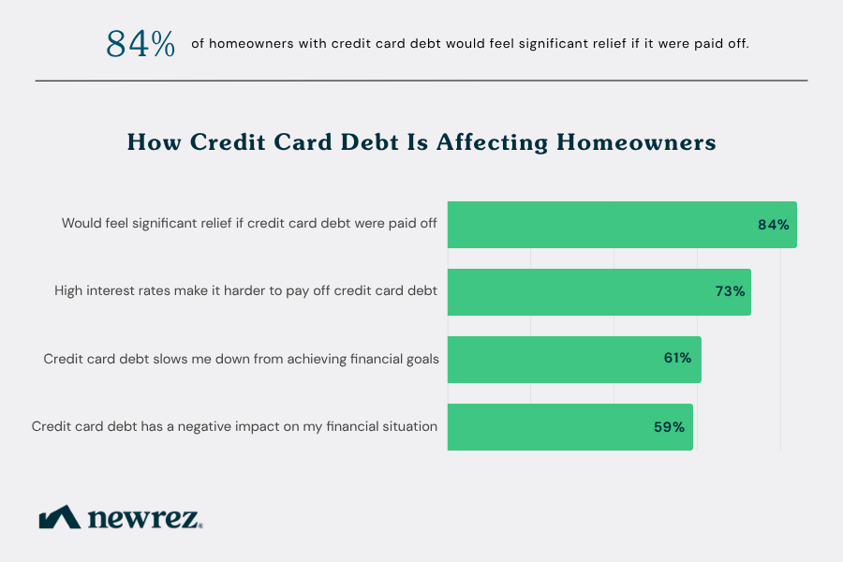
“Carrying a balance can be hard on homeowners,” the report states. “Eighty-four percent of surveyed homeowners with credit card debt would feel significant relief if credit card debt were paid off. Sixty-one percent say it’s slowing progress toward their financial goals, and 59% say it has a negative impact on their financial situation.”
Newrez Chief Commercial Officer Leslie Gillin says that homeowners are prioritizing their homes and “recognize the importance of homeownership” in a statement to RISMedia.
One of the biggest conclusions the report draws is the fact that—despite being bogged down by credit card debt—commitment to homeownership remains strong.
For homeowners with credit card debt…
- 89% stated that owning a home offers a sense of stability
- 89% agree that their home is a top financial asset
- 84% say that owning a home is one of the best ways to build wealth
For homeowners with both a mortgage and credit card debt…
- 90% prioritize mortgage payments over most other bills
- 89% are confident that they can keep up with their mortgage payments
“More than eight in 10 homeowners who carry credit card debt agree that owning a home is one of the best ways to build wealth, and even more say homeownership offers a sense of stability,” Gillin continues. “Encouragingly, an overwhelming majority of mortgage borrowers with credit card debt are confident they can keep up with their mortgage payments and consider these payments a priority.”
Homeowners with mortgages and credit card debt have reportedly cut back in spending due to their debts. About 41% of respondents state that they’ve cut back in travel, leisure or discretionary spending. Following closely behind, 37% reported that they’ve cut back in everyday expenses, such as groceries.
“Consumers have dealt with financial headwinds in recent years, with stubborn inflation at the top of the list, so it’s not surprising that they are making some tradeoffs,” Gillin says. “While 71% of homeowners with credit card debt told us they cut back in at least one area over the past year, the most common area is travel or discretionary spending, which shows prudent prioritization. Of course, not every household feels this pressure the same way, and for some, it’s been a real strain.”
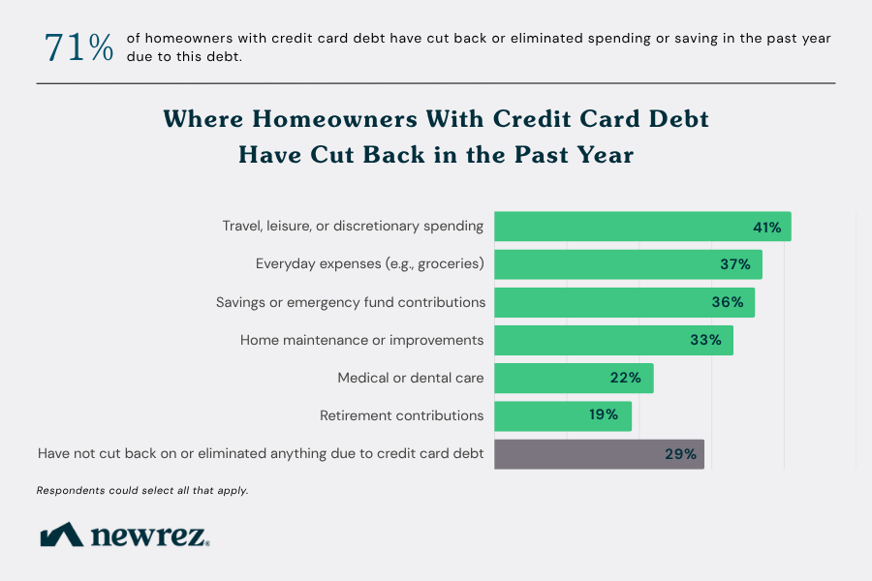
In other categories, 36% of respondents have cut back in savings or emergency fund contributions, 33% in home maintenance or improvements, 22% in medical or dental care and 19% in retirement contributions. Twenty-nine percent had reportedly not cut back or eliminated anything due to credit card debt, but the report also notes that respondents were able to select multiple options.
What it means
Although the report reflects data from homeowners this past summer, the Federal Reserve’s recent rate hike can have a lasting impact on all facets of the real estate market.
Gillin points out that the rate hike could make credit card debt more expensive for borrowers to carry, as “most cards carry a variable rate tied to the Fed’s benchmark.” While credit card debts may feel the repercussions of the rate increase, she also emphasizes that mortgage rates will remain unchanged for borrowers with fixed-rate mortgages.
“Nearly three-quarters of homeowners with credit card debt already say high interest rates make it harder to pay down what they owe, so one hike alone isn’t likely to shake confidence, but if the Fed raises rates again, the cumulative effect on credit card costs can start to add up,” she states.
Yet, Gillin calls the situation “encouraging” based on how homeowners are managing their debts.
“Overall, these consumers are smart, and they’re resilient. Many homeowners carrying credit card debt also carry strong credit profiles overall—with lower delinquency rates than renters, according to Federal Reserve research—and they’re paying close attention to their finances, adjusting their spending, and finding ways to adapt as market conditions and rates shift,” she says.
Newrez’s research does show promise, but the future of mortgages remains unclear. The latest data from ATTOM reveals that for Q2 2026, 3.2% of mortgaged residential properties are underwater—the term used for where the combined estimated loan balances are at least 25% more than the property’s estimated market value.
Trends
Although the data was not broken down based on generation, Gillin says that the trend is clear and consistent “across every age group.”
“From Gen Z to Baby Boomers, the majority of homeowners agree that owning a home provides a sense of stability and is one of the best ways to build long-term wealth,” she says. “We also see most homeowners across every generation confident in their ability to keep up with mortgage payments, reinforcing just how universal that dedication to homeownership is as a foundation for financial security.”
While homes are significant financial assets, a recent study by Harvard’s Joint Center for Housing Studies (JCHS) shows that the rate of young adult homeownership is at risk of declining—due to anti-immigration policies and a smaller Gen Alpha birth cohort.
Again, the Newrez survey reflects data from this past summer. But so far, fall 2026 has seen a slowdown of housing activity on many fronts. Consumer sentiment and confidence were both down throughout September, along with the rise of possible rate hikes in the future should inflation persist.
“It’s possible homeowners could feel more pressure because they’re also focused on protecting and maintaining their home—one of their most important financial assets, according to 89% of homeowners with credit card debt,” Gillin concluded. “Ultimately, though, credit card debt is a very personal situation that impacts everyone differently.”